Every framework, source referenced.
Browse the complete visual library beside chapter context and direct downloads.
A Practitioner’s Guide to Solving for Clarity in the Age of Artificial Intelligence
Direct answer: United We Transform is a practitioner's guide for leaders, facilitators, innovation teams, and event designers who need to turn organizational ambiguity into clear decisions and accountable action. The book introduces Collaborative Intelligence, the nine-part Collaborative Intelligence Canvas, the STACK engagement model, and the Cognitor role for responsible human-AI workflow design.

United We Transform helps leaders and practitioners combine human judgment, collective intelligence, and artificial intelligence without surrendering accountability. Its core frameworks - the Collaborative Intelligence Canvas, the STACK model, and the Cognitor role - help teams clarify the destination, design better engagements and decisions, and build responsible human-AI workflows that carry insight into action.
Nine connected elements for a shared destination, accountable choices, human-AI workflow, and ethical action.
Use the Canvas02Situation, Task, Action, Consequence, and Knowledge for consequential engagements.
Explore STACK03The human orchestrator of AI tools, evidence, interaction, synthesis, and accountability.
Design a workflowEvery guide contains a substantive summary, key ideas, named frameworks, all associated figures, and the complete chapter toolkit.
Diagnoses the organizational cost of ambiguity and explains why collaborative intelligence, AI augmentation, and a Reset Mindset must work together to create shared clarity. It introduces the nine-part canvas and connects clarity to execution, engagement, adaptability, and measurable value.
Read the chapter guide 02Defines UWT as an integrated organizational operating system rather than a stand-alone workshop method. It explains the nine mutually reinforcing elements, formally introduces the Cognitor, positions UWT alongside Design Thinking and Agile, and argues for redesigning structures and habits that perpetuate ambiguity.
Read the chapter guide 03Turns the UWT system into an implementation roadmap. The chapter moves from executive sponsorship and mindset formation through mission definition, AI-enhanced problem framing, stakeholder engagement, STACK-based working sessions, shared assets, and learning-oriented operations.
Read the chapter guideEvery vendor-neutral skill includes inputs, workflow, outputs, guardrails, a complete prompt, and a portable ZIP. All are ungated.
A source-aware diagnosis of where ambiguity is blocking a decision or initiative, followed by a prioritized set of questions, owners, and next actions that improve shared clarity.
Open the complete skill Free AI skillA first-draft Collaborative Intelligence Canvas that aligns nine connected elements of an initiative while exposing evidence gaps, tensions, AI opportunities, and human accountability.
Open the complete skill Free AI skillA purposeful engagement design that connects Situation, Task, Action, Consequence, and Knowledge, with participatory Scan-Focus-Act cycles, appropriate AI support, human decision rights, and follow-through.
Open the complete skill Free AI skillA pilot-ready human-AI workflow blueprint that assigns accountable human roles, bounded AI contributions, evidence and data requirements, validation gates, ethical guardrails, fallback paths, and impact measures.
Open the complete skillRole-specific paths connect the most relevant chapters, questions, and free tools.
Where is ambiguity slowing our most important decisions, and where can AI create value without weakening accountability?
Follow this path Reading pathHow do I design human-AI collaboration that improves the quality of participation, sense-making, decisions, and follow-through?
Follow this path Reading pathHow can our team use AI to widen the solution space, make better choices, and test ideas without confusing output volume with innovation?
Follow this path Reading pathWhat must people do together during this event, and what should exist, change, or continue when it ends?
Follow this pathAll 37 manuscript visuals are available at source resolution, individually and in one ZIP.
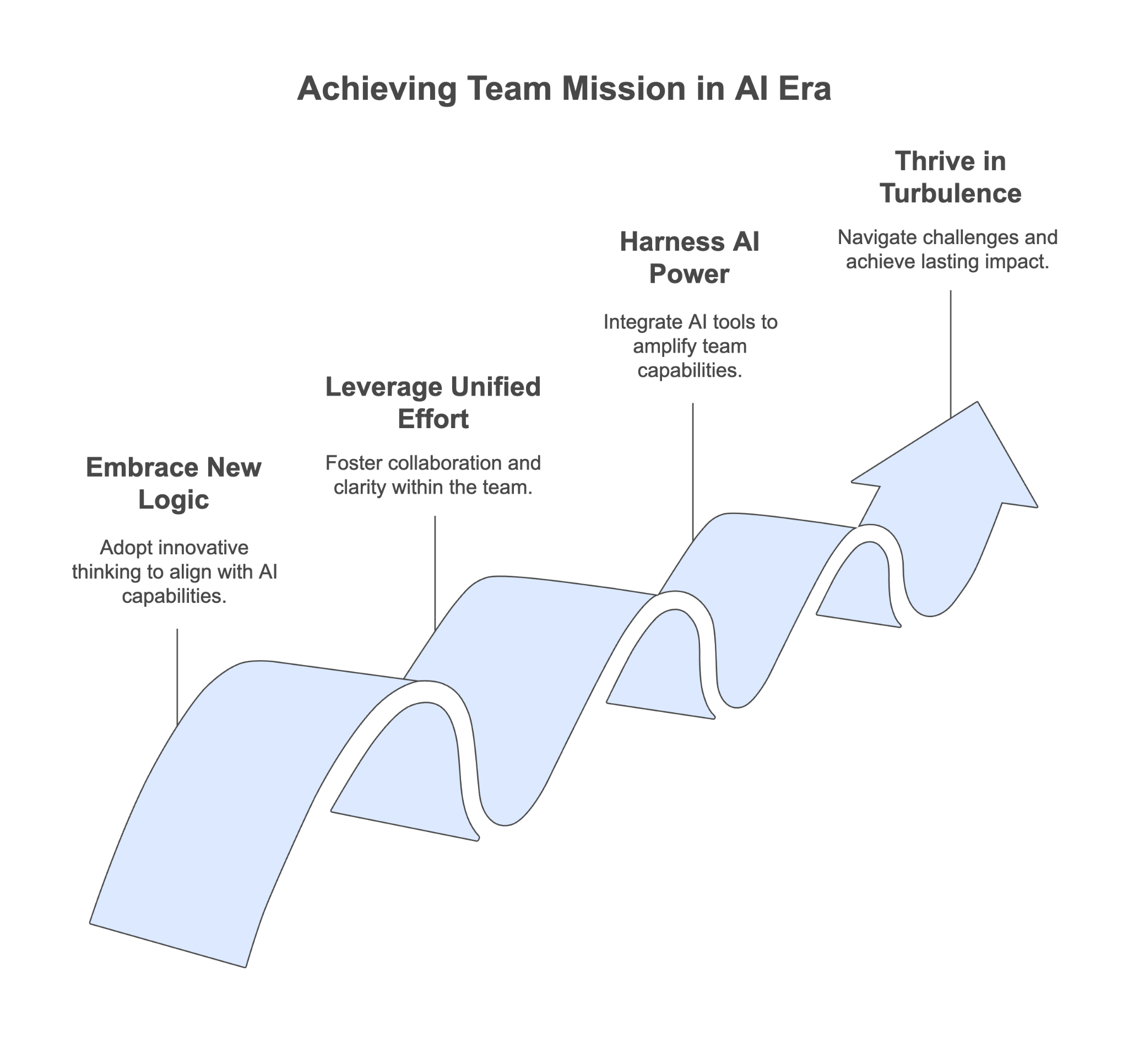
Browse the complete visual library beside chapter context and direct downloads.
Every excerpt links to its Amazon source and keeps purchase or relationship disclosures visible.
"Facilitators can leverage AI to maximize every event and still apply their skills they have honed over decades."
"The authors clearly have significant personal experience across industries applying their theories in the real world."
"The authors share a tried-and-tested approach that helps you organize large-group conversations."
Biographies here are concise paraphrases of the canonical manuscript's author section.
Tom Kehner is an architect of collaborative strategy whose work spans commercial, government, and social impact settings. He designs frameworks for collective sense-making and unified action and is described in the manuscript as a driving force behind the United We Transform movement.
Amazon author pageBrandon Klein applies artificial intelligence, AI agents, agentic workflows, and automation to decision-making and solution design. The manuscript identifies him as the founder of the United We Transform movement and emphasizes his focus on translating advanced automation into measurable organizational value.
Amazon author pageCanonical source note: this companion follows the attached 218-page manuscript. Amazon format pagination can differ; its hardcover listing reports 203 pages. The complete manuscript PDF is not published here.