Move in order, then revisit the system.
Start with destination and strategic bets. Make value, measures, roles, AI, data, flow, culture, and ethics explicit. Then inspect where an answer in one element changes another.
A nine-element canvas for articulating objectives, considerations, and present realities while specifying how human insight and AI capabilities will work together.
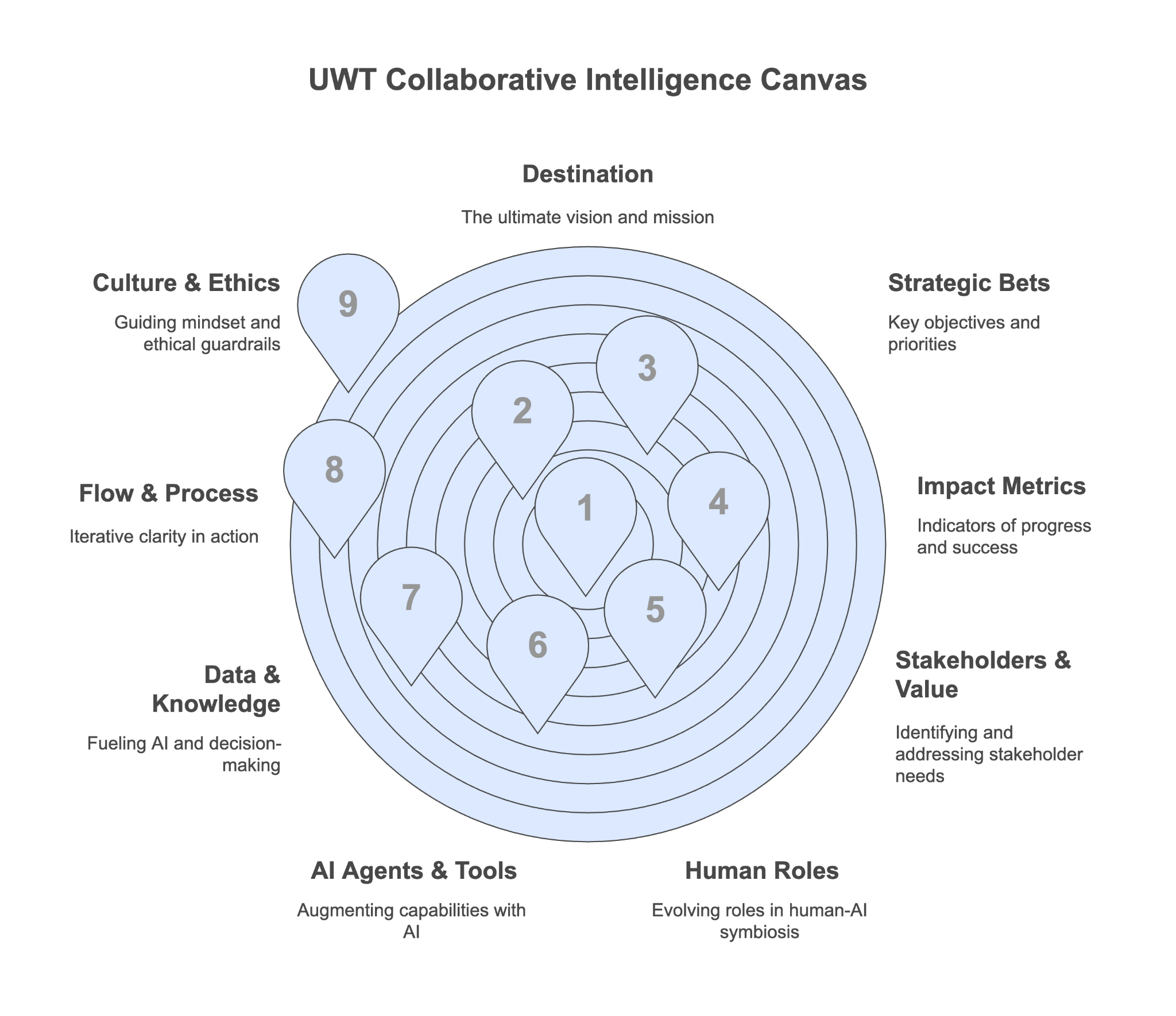
Start with destination and strategic bets. Make value, measures, roles, AI, data, flow, culture, and ethics explicit. Then inspect where an answer in one element changes another.
North Star Vision and Mission
Define your aspirational future state (the Vision) and the core purpose that drives you (the Mission). What is the ultimate destination, result, or impact your team/organization is striving to achieve? Why is this compelling and motivating for all stakeholders? How does it connect to a larger Movement?
Identify specific AI tools and techniques to synthesize diverse inputs (e.g., global market trends, deep customer unmet needs analysis, societal shifts, competitive foresight, etc.) for a richer, data-informed articulation of this desired future state. How can generative AI assist in drafting initial Vision/Mission statements or exploring alternative future scenarios?
Canonical manuscript source page 13
Key Objectives and Priorities
Articulate the deliberate, high-impact choices and key objectives your team/organization will prioritize to make significant progress towards your Destination. What are the 2-3 critical "bets" you are making with your resources (e.g., time, talent, capital)? Ensure these are focused and clearly differentiate what you will do from what you will not do.
Detail how AI modeling, simulation, or predictive analytics will be used to evaluate the potential ROI, risks, and resource implications of different strategic bets. How can AI help identify interdependencies or hidden opportunities related to these priorities?
Canonical manuscript source page 13, 14
Key Performance Indicators and Success Stories
Define the clear, measurable Key Performance Indicators (KPIs) that will track progress towards your Strategic Bets and ultimately your Destination. Complement these with a plan to identify and articulate compelling qualitative success stories (the impactful Moments) that bring the data to life and illustrate the human impact of your efforts.
Specify AI tools for real-time KPI tracking, anomaly detection in performance data, predictive forecasting of metric achievement, and potentially AI-assisted analysis of qualitative feedback (e.g., customer testimonials, employee narratives) to identify and help draft compelling success stories.
Canonical manuscript source page 14
Identifying Winners and Addressing Worries
Map out all key internal and external stakeholders impacted by or crucial to achieving your Destination. For each stakeholder group, clearly define the unique value this initiative aims to deliver to them. Proactively identify and articulate their potential concerns, fears, or "worries," and outline strategies to address them.
Describe how AI (e.g., sentiment analysis of social media or customer forums, network analysis of internal communications, etc.) can be used to identify stakeholder groups, understand their current perceptions, and anticipate their reactions or needs. How can AI personalize communication to address specific stakeholder concerns?
Canonical manuscript source page 14, 15
The Emergent Cognitors
Define the key human capabilities and roles essential for this initiative's success. Clarify responsibilities for all team members. Crucially, specify how the skills and mindset of the Cognitor (as introduced in Chapter 2 and detailed in Chapter 6), orchestrating human-AI collaboration, strategic questioning, synthesis, etc., will be leveraged or developed within the team.
Identify AI tools that can augment specific human roles (e.g., AI research assistants for analysts, AI co-pilots for project managers, AI content aids for communicators). How will AI support the Cognitor in their orchestration tasks (e.g., AI for meeting facilitation, information synthesis for sensemaking, etc.)?
Canonical manuscript source page 15
AI-Augmenting Superpowers
List the specific AI agents, platforms, or categories of AI tools that will be strategically deployed as "superpowers" to augment human capabilities across this initiative. For each, define its purpose and intended contribution. Ensure there's a plan for ethical review and responsible deployment.
Detail the selection criteria for the AI tools. How will their performance and utility be evaluated? What is the plan for training teams to use them effectively and for integrating them into existing workflows?
Canonical manuscript source page 15, 16
The Fuel and Identification of Gaps
Identify the critical internal and external data sources that will "fuel" both human decision-making and AI model training/operation for this initiative. Assess the quality, accessibility, and governance of this data. Pinpoint significant knowledge gaps and outline strategies for addressing them.
Describe how AI will be used to process, clean, synthesize, and analyze the identified data sources. How can AI help identify hidden patterns or correlations within the data that humans might miss? Specify AI tools for building and maintaining a dynamic, accessible knowledge base from the insights generated.
Canonical manuscript source page 16
Leveraging the STACK Model for Clarity in Action
Outline the core collaborative workflows and decision-making processes that will drive this initiative. Detail how adaptable frameworks like the STACK model (as detailed in Chapter 3) will be employed to bring structure, clarity, and AI-augmented intelligence to these flows, especially for complex problem-solving and solution design phases.
For each stage of your key processes, specify where AI will provide input, automate steps, facilitate interaction, or analyze outputs. How will AI enable rapid iteration within these processes? Detail any agentic AI automations planned for highly repeatable tasks.
Canonical manuscript source page 16, 17
The Guiding Mindset and Guardrails
Describe the essential cultural attributes (e.g., Reset Mindset, psychological safety for AI experimentation, transparency, continuous learning) that must be nurtured to ensure the success of this AI-augmented initiative. Define the clear ethical guardrails, principles, and governance mechanisms that will guide all AI development and deployment.
How can AI tools or data be used (ethically) to provide insights into current cultural indicators (e.g., AI analysis of anonymized employee feedback on AI readiness)? How will AI itself be used to support training on ethical AI principles or to monitor adherence to established guardrails (e.g., bias detection tools)?
Canonical manuscript source page 17