What are the 9 elements of United We Transform?
Direct answer: The 9 elements of United We Transform are Destination, Strategic Bets, Impact Metrics, Stakeholders & Value, Human Roles, AI Agents & Tools, Data & Knowledge, Flow & Process, and Culture & Ethics. They work as one operating system, so a change in one element shows up in the others.
The nine elements.
Each line is a plain reading of the book's lexicon entry on pages 211 and 212.
- Destination. The shared picture of the future, plus the mission that guides the work.
- Strategic Bets. The few objectives and priorities you deliberately choose to pursue.
- Impact Metrics. The measures and success stories that show whether the bets are paying off.
- Stakeholders & Value. Who wins, who worries, and what value each group needs to see.
- Human Roles. Clear responsibilities, including the Cognitor who orchestrates human and AI work.
- AI Agents & Tools. Which AI agents and tools you choose, and how you deploy them ethically and well.
- Data & Knowledge. The data and know-how that feed decisions, and the knowledge you're still missing.
- Flow & Process. How work and collaboration flow, often through the STACK model.
- Culture & Ethics. The Reset Mindset, psychological safety for experiments, and guardrails for AI.
Where it sits in the book.
Chapter 2 introduces the nine elements as one architecture, not a checklist. Change one and the others move.
That's why the book's Collaborative Intelligence Canvas puts all nine on a single page. The elements are the system. The Canvas is the tool you use to map them on a real initiative.
How it shows up in real gatherings.
Evidence from the Atlas: 23,624 public event agendas scored with the published rubric.
The Atlas scores 23,624 public event agendas. It can't see a team's Destination, but it can see whether an agenda names a real problem and plans to measure progress. That's where Strategic Bets and Impact Metrics show up in public. Problem specificity averages 30.1 out of 100. Only 284 agendas show a visible baseline, 319 show tracking, and 298 show impact evidence. Each of those three is under 1.5 percent of the Atlas, so Impact Metrics is the element public gatherings leave empty most often.
Data: Gathering statistics · Design mechanisms · How the score works. Scores describe the published agenda, not the event's worth.
The figure in the book.
Source-resolution diagram from the canonical manuscript.
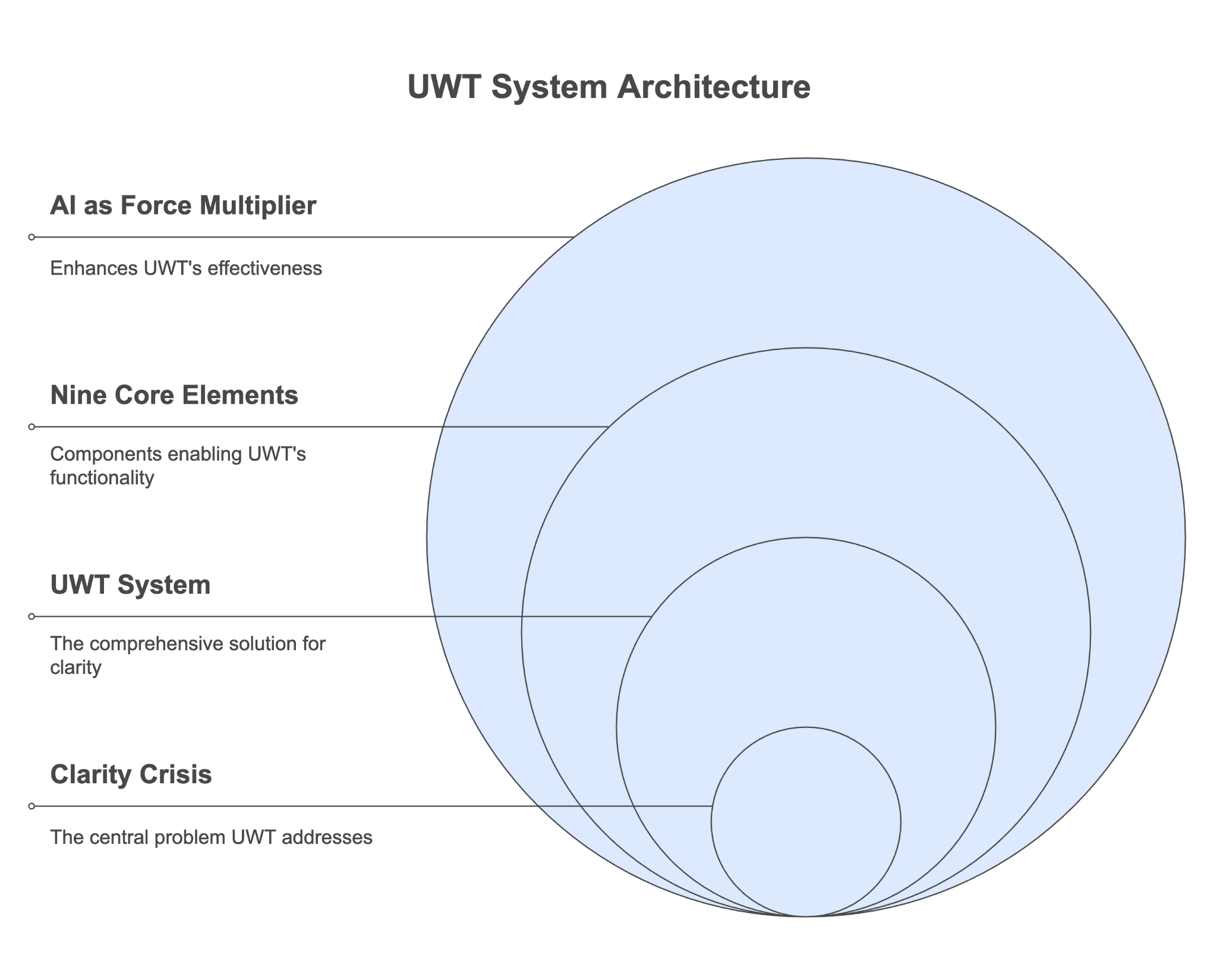
Figure 2.1: The UWT System Architecture
Canonical manuscript page 56Questions people ask.
- Are the 9 elements the same as the Collaborative Intelligence Canvas?
- No. The elements are the operating system. The Canvas is the one-page tool for mapping all nine on a live initiative, so a team can see where its answers conflict.
- Which element should a team start with?
- The book's Canvas starts with Destination and Strategic Bets. Then it makes value, measures, roles, AI, data, flow, culture and ethics explicit, and checks where one answer changes another.
- Where does the Cognitor fit?
- Inside Human Roles. The Cognitor is the person who orchestrates human judgment and AI tools across the other eight elements.
- Where are the 9 elements in the book?
- Chapter 2, The United We Transform Operating System, pages 56 to 62. The lexicon defines each element on pages 211 and 212.
Keep going.
Which of the nine would your team struggle to write down today?
Source boundary: this definition draws on canonical manuscript pages 56 to 62 and the book's lexicon. It summarizes the framework and does not reproduce the chapter prose.