What is the STACK model?
Direct answer: The STACK model is the United We Transform sequence for running a consequential engagement: Situation, Task, Action, Consequence, Knowledge. It moves a group from shared context to a focused task, then to action, modeled outcomes, and knowledge the organization keeps.
The five stages.
The letters run in order. Each stage has its own job and its own AI role.
- Situation. Build a shared picture of the context. AI can scan wide sources and draft a baseline.
- Task. Define one focused objective and tie it to strategy.
- Action. Run the engagement. This is where rapid Scan, Focus, Act cycles live.
- Consequence. Model what each option would cause before anyone commits.
- Knowledge. Keep what the group learned and share it, so the next team starts ahead.
Where it sits in the book.
STACK sits inside the Flow & Process element. Chapter 3 introduces it as the working-session engine of implementation.
The lexicon calls it structured yet adaptable. The book uses it for AI-powered engagements, collaborative problem solving, solution design sprints and effective meetings.
How it shows up in real gatherings.
Evidence from the Atlas: 23,624 public event agendas scored with the published rubric.
Public agendas show where STACK breaks. Across 23,624 scored agendas, 10,888 show visible participant work, the Action stage. Only 1,030 show commitments, the closest public trace of Consequence. Just 284 show a baseline, the trace of Situation, and 52 show follow-up after the event, the trace of Knowledge. Overall, 92.2 percent (21,781) show no visible follow-up, tracking or impact evidence. The A shows up far more often than the K.
Data: Gathering statistics · Design mechanisms · How the score works. Scores describe the published agenda, not the event's worth.
The figure in the book.
Source-resolution diagram from the canonical manuscript.
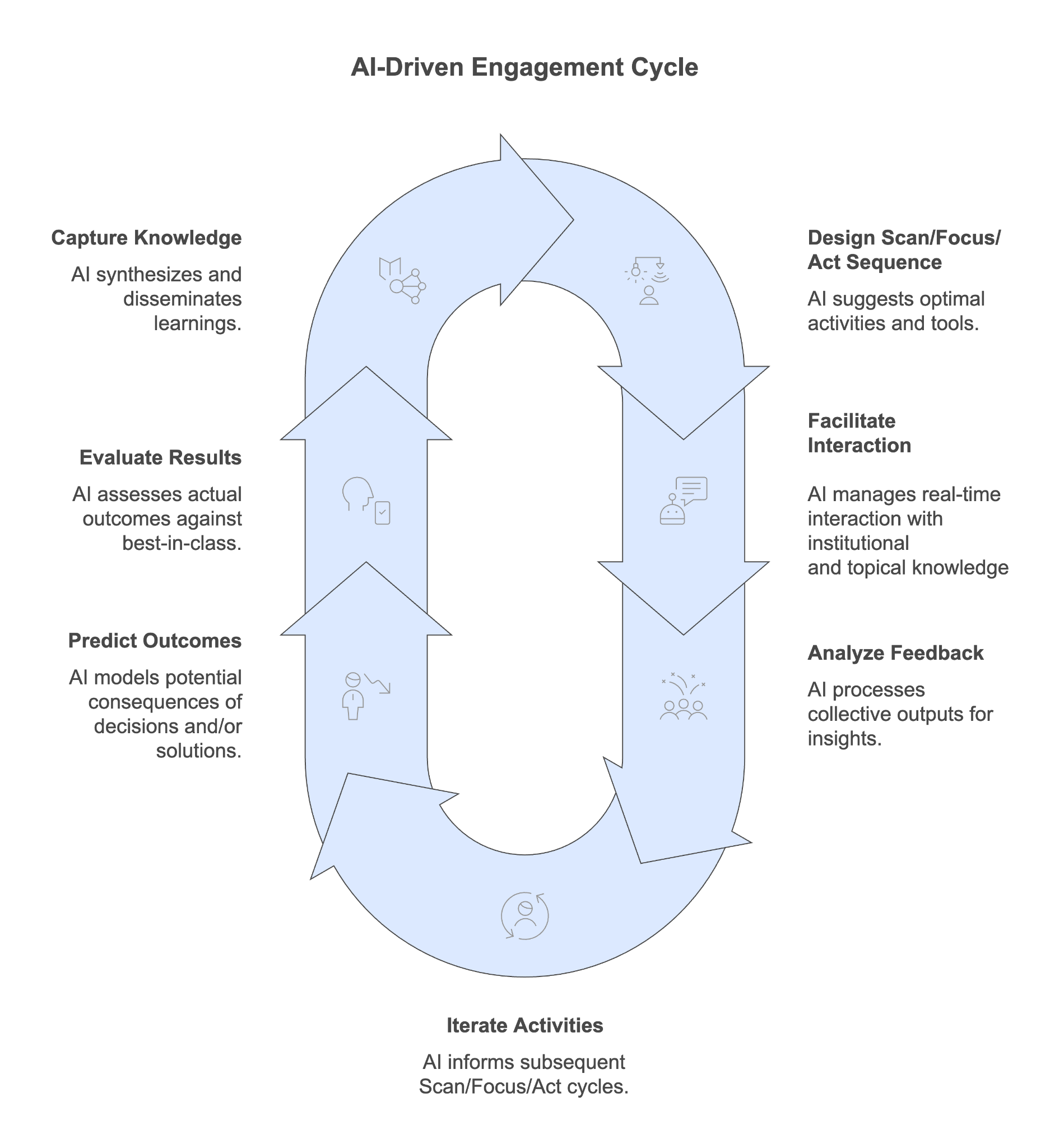
Figure 3.3: AI-driven STACK Sequence
Canonical manuscript page 94Questions people ask.
- What does STACK stand for?
- Situation, Task, Action, Consequence, Knowledge.
- How is STACK different from Scan, Focus, Act?
- STACK is the whole sequence. Scan, Focus, Act is the fast loop the book runs inside STACK stages, above all inside Action.
- Is STACK only for workshops?
- No. The book's lexicon lists AI-powered engagements, collaborative problem solving, solution design sprints and effective meetings.
- Where is STACK in the book?
- Chapter 3, pages 93 to 96, with the AI-driven STACK sequence in Figure 3.3 on page 94. The lexicon entry is on page 214.
Keep going.
Which letter does your next gathering skip?
Source boundary: this definition draws on canonical manuscript pages 93 to 96 and the book's lexicon. It summarizes the framework and does not reproduce the chapter prose.