Rope House
Pairs or small groups lay a single piece of cord flat on a table to match a six-segment house diagram across three escalating rule levels. Participants test whether the entire cord can trace the outline without crossing and whether both ends can meet.
Choose this exercise
Purpose: Practice testing constraints and recognizing an impossible structural requirement through tactile modeling.
Use it when: Use during a workshop on problem solving or requirements analysis when teams need a concrete puzzle about testing assumptions against real constraints.
Skip it when: Skip when tabletop space is unavailable, when physical cord manipulation is unwelcome, or when a group needs an entirely solvable closing exercise.
Group arrangement: Pairs or trios working at separate flat tables.
Timing: UWT 15-minute plan based on the short puzzle format documented on Playmeo.
Materials and tools
- One 2-meter piece of soft cord or supple rope per pair or trio
- One printed copy of the UWT Rope House diagram card per pair or trio
- Scratch paper and one pencil per pair or trio for tracing paths
- One timer for the facilitator
Before participants arrive
- Cut soft cord into 2-meter lengths, one per team.
- Print one copy of the diagram card for each station.
- Clear flat table surfaces so cords can lie completely flat.
Say this to open
Work with your table partner using this cord and diagram card. Lay the entire length of your cord flat on the table to match the six segments of the house. Scale the shape so you use the full cord. We will work through three levels of success: first, match the shape; second, trace it with no overlaps or crossings; third, test whether both loose ends can finish at the same corner.
How to run it
Introduce levels and test Level 1 3 minutes
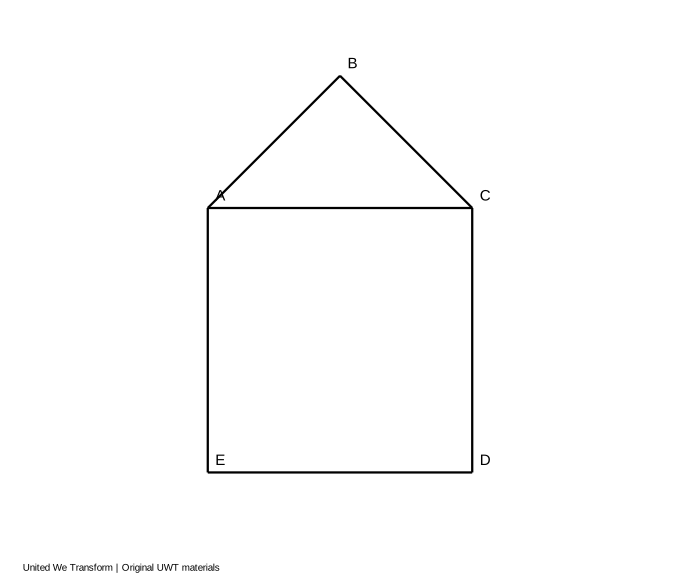
Distribute one cord, one diagram card, scratch paper, and a pencil to each small group. Point out the five junction points A, B, C, D, and E and the six segments. Explain Level 1: use the full cord flat on the table to form the complete outline. Scale the house so no loose cord is left dangling. Touching a junction point is allowed and does not count as crossing over rope. Give teams 2 minutes to complete Level 1.
Attempt Level 2 without overlap 5 minutes
Announce Level 2: recreate the identical shape using every segment exactly once, with no rope crossing over itself and no doubled lengths. Let teams test paths with the cord or trace paths on scratch paper. Check each table. For Level 2, verify that the cord touches junction points cleanly without overlapping. If a team finishes early, ask them to find a different starting point that still satisfies Level 2.
Investigate Level 3 loop constraint 4 minutes
Introduce Level 3: retain all Level 2 rules, but bring both cut ends of the cord to the exact same junction point. Give teams 3 minutes to test whether this can be done. Circulate and observe their attempts. If groups become frustrated, encourage them to tally how many segments meet at each junction point on their diagram card.
Debrief mathematical limits and requirements 3 minutes
Stop all cord movement. Reveal that Level 3 is mathematically impossible on this diagram because junctions A and C each have three connecting segments, requiring an open path that starts at one and ends at the other. Invite two participants to share how they recognized the boundary and how teams handle project requirements that cannot be met as stated.
Debrief questions
- At what point did your team suspect that Level 3 could not be solved as written?
- How did you distinguish between a failed layout attempt and a structural constraint that was mathematically impossible?
- When a project requirement turns out to be impossible, what concrete conversation needs to happen next?
Finished output: A completed Level 2 rope layout on each table, followed by a group consensus on why Level 3 cannot be completed on the given diagram.
Remote
Each remote participant needs a 2-meter cord or shoelace and a copy of the UWT Rope House diagram. Working in digital breakout pairs, one person manipulates cord flat on their desk while tilting their camera downward. The partner traces proposed paths on paper and gives verbal directions. Return to the main room for the mathematical reveal and debrief.
Hybrid
In-person pairs work at physical tables. Remote participants work in remote-only breakout pairs using their own home cord or digital drawing tool. A designated shared camera broadcasts one in-person table layout to the remote group during the debrief.
Access and participation choices
- Participants who prefer not to manipulate cord can direct paths or test routes on paper with a pencil.
- Any participant may observe without hands-on manipulation and pass during whole-room debrief.
If the session gets stuck
- Participants confuse touching a junction point with crossing over rope.
- Clarify that multiple segments terminating at the same vertex is permitted. A crossing occurs only when cord physically lays across the top of another cord segment.
- A group insists they solved Level 3 by overlapping rope or leaving out the ceiling segment AC.
- Inspect the table together. Point out that all six segments must be present and each must be traversed exactly once without any overlap.
Terms used here
- Junction: A corner point where two or more straight rope segments meet.
- Open path: A continuous route that visits every line segment exactly once without starting and ending at the same point.
UWT Rope House Diagram Card
Run this exercise live
The facilitator console stays in this browser. Its QR handoff is a short-lived participant snapshot containing only public exercise instructions, phase, prompt, and timer state.
What participants need now
Materials:
This is a participant-safe snapshot, not a response form. It sends nothing back to the facilitator.
Run this with your AI assistant +
Works with Claude, ChatGPT, Gemini, or your own local model: paste this prompt and your AI will co-facilitate this exercise with you.
Help me prepare and run the exercise below. First ask for my participant count, time, setting, access needs and intended result. Check these against the stated limits. Use the supplied rules and materials. Explain any proposed changes before using them, and label them as adaptations. Do not invent source claims or require personal disclosure. Give me one step at a time when I say start. I manage the people, physical activity and clock; do not claim to observe the room. Ask me what happened before choosing a next step.
Reference revision: 4a0445ee2864708ceb8e66021fd5c8d2b4d52ef38fe9ef4fa07223e67f7c1771
# Rope House
Pairs or small groups lay a single piece of cord flat on a table to match a six-segment house diagram across three escalating rule levels. Participants test whether the entire cord can trace the outline without crossing and whether both ends can meet.
**Time:** 15 minutes. UWT 15-minute plan based on the short puzzle format documented on Playmeo.
**People:** 4 to 24. Pairs or trios working at separate flat tables.
## Choose this exercise
**Purpose:** Practice testing constraints and recognizing an impossible structural requirement through tactile modeling.
**Use it when:** Use during a workshop on problem solving or requirements analysis when teams need a concrete puzzle about testing assumptions against real constraints.
**Skip it when:** Skip when tabletop space is unavailable, when physical cord manipulation is unwelcome, or when a group needs an entirely solvable closing exercise.
## Materials and tools
- One 2-meter piece of soft cord or supple rope per pair or trio
- One printed copy of the UWT Rope House diagram card per pair or trio
- Scratch paper and one pencil per pair or trio for tracing paths
- One timer for the facilitator
## Before participants arrive
1. Cut soft cord into 2-meter lengths, one per team.
2. Print one copy of the diagram card for each station.
3. Clear flat table surfaces so cords can lie completely flat.
## Say this to open
Work with your table partner using this cord and diagram card. Lay the entire length of your cord flat on the table to match the six segments of the house. Scale the shape so you use the full cord. We will work through three levels of success: first, match the shape; second, trace it with no overlaps or crossings; third, test whether both loose ends can finish at the same corner.
## How to run it
### 1. Introduce levels and test Level 1 (3 minutes)
Distribute one cord, one diagram card, scratch paper, and a pencil to each small group. Point out the five junction points A, B, C, D, and E and the six segments. Explain Level 1: use the full cord flat on the table to form the complete outline. Scale the house so no loose cord is left dangling. Touching a junction point is allowed and does not count as crossing over rope. Give teams 2 minutes to complete Level 1.
### 2. Attempt Level 2 without overlap (5 minutes)
Announce Level 2: recreate the identical shape using every segment exactly once, with no rope crossing over itself and no doubled lengths. Let teams test paths with the cord or trace paths on scratch paper. Check each table. For Level 2, verify that the cord touches junction points cleanly without overlapping. If a team finishes early, ask them to find a different starting point that still satisfies Level 2.
### 3. Investigate Level 3 loop constraint (4 minutes)
Introduce Level 3: retain all Level 2 rules, but bring both cut ends of the cord to the exact same junction point. Give teams 3 minutes to test whether this can be done. Circulate and observe their attempts. If groups become frustrated, encourage them to tally how many segments meet at each junction point on their diagram card.
### 4. Debrief mathematical limits and requirements (3 minutes)
Stop all cord movement. Reveal that Level 3 is mathematically impossible on this diagram because junctions A and C each have three connecting segments, requiring an open path that starts at one and ends at the other. Invite two participants to share how they recognized the boundary and how teams handle project requirements that cannot be met as stated.
## Debrief questions
- At what point did your team suspect that Level 3 could not be solved as written?
- How did you distinguish between a failed layout attempt and a structural constraint that was mathematically impossible?
- When a project requirement turns out to be impossible, what concrete conversation needs to happen next?
**Finished output:** A completed Level 2 rope layout on each table, followed by a group consensus on why Level 3 cannot be completed on the given diagram.
## Remote
Each remote participant needs a 2-meter cord or shoelace and a copy of the UWT Rope House diagram. Working in digital breakout pairs, one person manipulates cord flat on their desk while tilting their camera downward. The partner traces proposed paths on paper and gives verbal directions. Return to the main room for the mathematical reveal and debrief.
## Hybrid
In-person pairs work at physical tables. Remote participants work in remote-only breakout pairs using their own home cord or digital drawing tool. A designated shared camera broadcasts one in-person table layout to the remote group during the debrief.
## Access and participation choices
- Participants who prefer not to manipulate cord can direct paths or test routes on paper with a pencil.
- Any participant may observe without hands-on manipulation and pass during whole-room debrief.
## If the session gets stuck
**Participants confuse touching a junction point with crossing over rope.**
Clarify that multiple segments terminating at the same vertex is permitted. A crossing occurs only when cord physically lays across the top of another cord segment.
**A group insists they solved Level 3 by overlapping rope or leaving out the ceiling segment AC.**
Inspect the table together. Point out that all six segments must be present and each must be traversed exactly once without any overlap.
## Terms used here
- Junction: A corner point where two or more straight rope segments meet.
- Open path: A continuous route that visits every line segment exactly once without starting and ending at the same point.
## Participant material: UWT Rope House Diagram Card
ROPE HOUSE DIAGRAM

Visual Layout:
B (peak)
/ \
/ \
A-----C (ceiling)
| |
| |
E-----D (floor)
Junctions:
- A: Top-left wall corner
- B: Roof peak
- C: Top-right wall corner
- D: Bottom-right wall corner
- E: Bottom-left wall corner
Target Segments (6 total):
1. AB (Left roof slope)
2. BC (Right roof slope)
3. CD (Right wall)
4. DE (Floor)
5. EA (Left wall)
6. AC (Ceiling / horizontal crossbar)
Rules:
- Level 1: Make this outline using your entire cord laid flat on the table.
- Level 2: Lay the cord so every segment is used once, with no rope crossing over itself and no doubling.
- Level 3: Satisfy Level 2 while having both ends of the cord meet at the exact same junction point.
Note for Facilitators Only:
Valid Level 2 path: Start at A, trace to B, then C, D, E, A, and finish across the ceiling at C (or the exact reverse starting at C and ending at A). Level 3 is mathematically impossible because junctions A and C each have exactly 3 incident segments. A closed loop requires every junction to have an even number of segments.
## Sources and adaptation
Observed on Playmeo, titled Rope House and attributed to Mark Collard. The specific six-segment network diagram and graph theory proof were supplied in United We Transform records.
Preserves the three progressive levels of success and flat-surface rope puzzle mechanic documented by Playmeo. United We Transform supplied the explicit six-segment geometric diagram (nodes A through E, segments AB, BC, CD, DE, EA, AC), rendered the required SVG diagram markup, verified the Level 2 open path, added the visual layout description and formal Euler path explanation proving Level 3 impossibility, and added structured facilitation timing, scripts, and debrief prompts.
[Playmeo](https://www.playmeo.com/activities/fun-team-building-puzzles/rope-house)
[Playmeo](https://www.playmeo.com/activities/fun-team-building-puzzles/rope-house/)
Current run sheet: https://unitedwetransform.com/exercises/rope-puzzle-challenge-develops-persistence-logic-rope-house/Sources and adaptation
Observed on Playmeo, titled Rope House and attributed to Mark Collard. The specific six-segment network diagram and graph theory proof were supplied in United We Transform records.
Preserves the three progressive levels of success and flat-surface rope puzzle mechanic documented by Playmeo. United We Transform supplied the explicit six-segment geometric diagram (nodes A through E, segments AB, BC, CD, DE, EA, AC), rendered the required SVG diagram markup, verified the Level 2 open path, added the visual layout description and formal Euler path explanation proving Level 3 impossibility, and added structured facilitation timing, scripts, and debrief prompts.
See our editorial policy for AI use, sourcing and corrections.