T Puzzle: UWT Four-Piece Version
Pairs or trios work to assemble four custom flat geometric pieces into an exact capital T silhouette. Groups test spatial hypotheses, confront false assumptions about seams, and analyze their team trial process.
Choose this exercise
Purpose: Arrange four geometric pieces into an exact capital T silhouette without gaps or overlapping edges.
Use it when: Use as a focused team warmup or transitional exercise to examine how groups test hypotheses, challenge unstated assumptions, and handle stuck states.
Skip it when: Skip when the session lacks tables or flat assembly surfaces, or when the group needs conceptual discussion rather than a concrete mechanical puzzle.
Group arrangement: Pairs or trios
Timing: Based on the 5 to 15 minute band in observed records; 15 minutes provides ample time for assembly attempts, solution reveal, and debrief.
Materials and tools
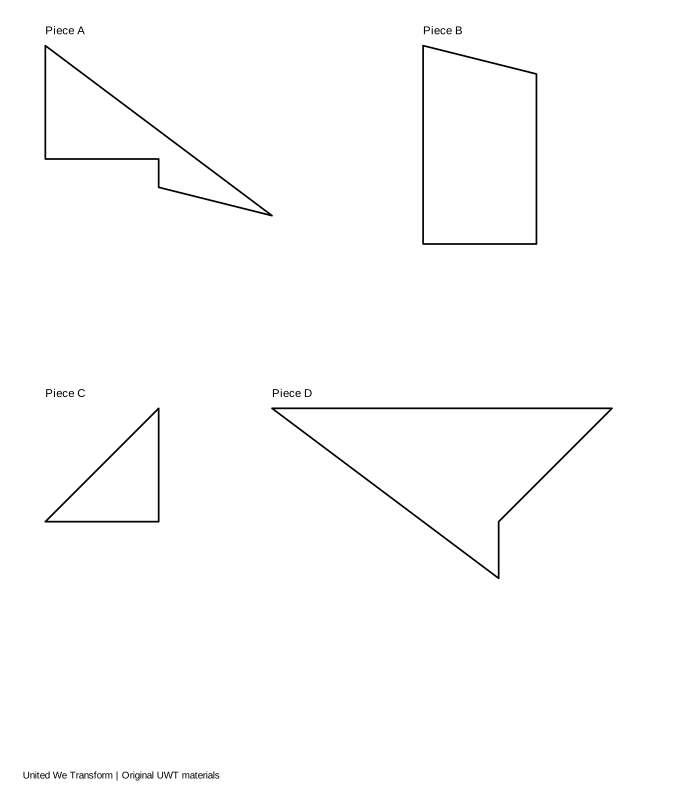
- One envelope containing the 4 cutout pieces per group, pre-cut from heavy paper or cardstock
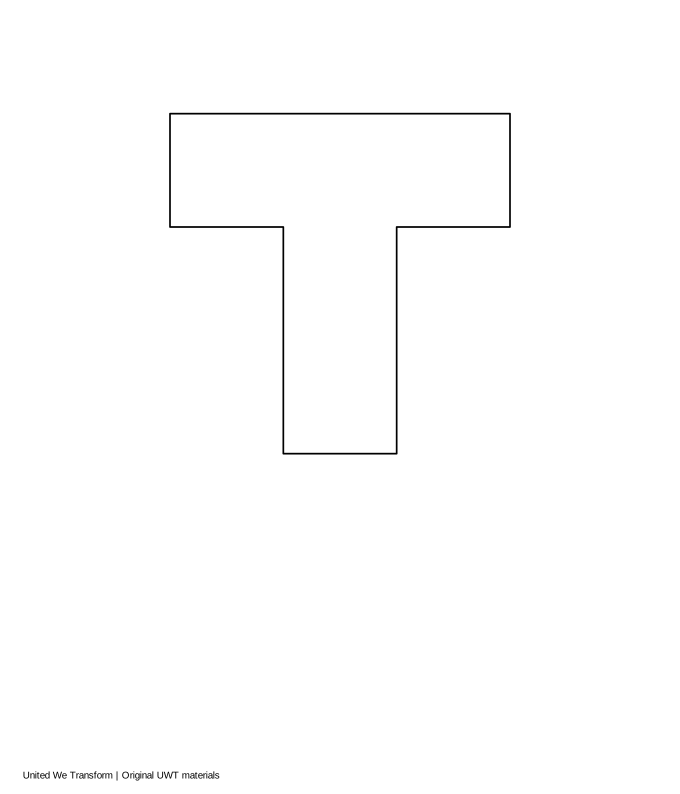
- One printed target sheet showing the full T silhouette per group
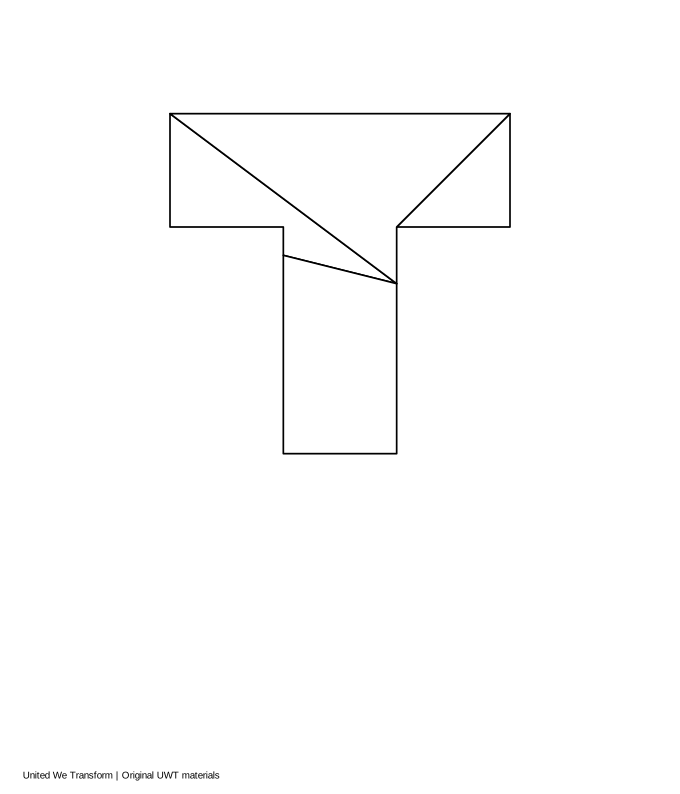
- One printed facilitator solution sheet kept private by the facilitator
- Scissors for setup preparation
- Scratch paper and pen per group for drafting ideas
Before participants arrive
- Print cutout sheets on cardstock at 100 percent scale.
- Using scissors, carefully cut out the four pieces for each set.
- Test-fit every set against the target sheet to ensure accurate cut edges.
- Place each four-piece set into an opaque envelope.
- Print one target sheet per team and keep the solution sheet hidden.
Say this to open
Your table has four geometric pieces and an outline of a capital letter T. Working together, arrange all four pieces to fill the outline completely. Pieces must lay flat with no overlaps, gaps, or folds. You may rotate pieces or flip them over. You have seven minutes to solve it.
How to run it
Introduce challenge and distribute sets 2 minutes
Welcome the room and explain the objective using the opening script. Distribute one envelope of four pieces and one target silhouette sheet to each pair or trio. Confirm everyone understands that pieces must lay flat without overlapping or bending.
Assemble the T 7 minutes
Start the timer. Groups manipulate the four pieces flat on the table, testing orientations against the target silhouette. Move between groups to observe interactions and verify pieces remain flat. Do not give placement hints. If a team solves it early, instruct them to scramble the pieces and reproduce the solution once more.
Display solution and compare 3 minutes
Call time on testing. If any group succeeded, invite them to let neighbors view their layout. For groups still working, display the facilitator solution diagram or guide them to place Piece 4 across the top seam. Give everyone 90 seconds to match the finished layout.
Debrief problem-solving process 3 minutes
Run a brief whole-room debrief using the prompt questions. Collect up to three observations about common layout assumptions, communication, and how teams decided to abandon an approach that stalled.
Debrief questions
- Where did your team assume the straight edges or diagonal seams had to go?
- What signal told your group to scrap a layout rather than keep nudging the same pieces?
- How did your group manage turns or agree on which layout to test next?
Finished output: Four polygon pieces arranged to fill the target capital T outline without gaps or overlaps, or an analyzed record of attempted layouts.
Remote
Distribute a slide or virtual whiteboard file to each breakout pair with the four polygon vector shapes placed beside the target outline. Enable rotation and free movement. Pairs work in breakout rooms for 7 minutes, then return to the main room.
Hybrid
Remote participants manipulate digital polygon shapes on a shared vector canvas while in-person pairs assemble paper cutouts. In-person tables point a webcam at their workspace or upload a final photo so both cohorts compare layouts.
Access and participation choices
- Participants who prefer not to manipulate small pieces can direct placement verbally, track trial configurations, or observe.
- Any participant may decline hands-on manipulation or pass during debrief questions without explanation.
If the session gets stuck
- Participants believe their cut pieces are missing an edge or misprinted.
- Remind them that all four pieces form the exact 3x3 T silhouette when correctly angled, and suggest testing diagonals that cross between the stem and the bar.
- One team member dominates the physical cutouts while others disengage.
- Pause the group and suggest taking single-piece placement turns, or have the non-handling partner dictate moves while the other places pieces.
Terms used here
- Dissection: The act of dividing a geometric shape into smaller polygon pieces that reassemble into target shapes.
T-Puzzle Cutout Sheet
T-Puzzle Target Silhouette
Facilitator Solution Key and Coordinate Data
Run this exercise live
The facilitator console stays in this browser. Its QR handoff is a short-lived participant snapshot containing only public exercise instructions, phase, prompt, and timer state.
What participants need now
Materials:
This is a participant-safe snapshot, not a response form. It sends nothing back to the facilitator.
Run this with your AI assistant +
Works with Claude, ChatGPT, Gemini, or your own local model: paste this prompt and your AI will co-facilitate this exercise with you.
Help me prepare and run the exercise below. First ask for my participant count, time, setting, access needs and intended result. Check these against the stated limits. Use the supplied rules and materials. Explain any proposed changes before using them, and label them as adaptations. Do not invent source claims or require personal disclosure. Give me one step at a time when I say start. I manage the people, physical activity and clock; do not claim to observe the room. Ask me what happened before choosing a next step. Reference revision: f91dac2fc9985675737139cd3213b7b48859e900ee99d4cfd4f465c9597b4ccf # T Puzzle: UWT Four-Piece Version Pairs or trios work to assemble four custom flat geometric pieces into an exact capital T silhouette. Groups test spatial hypotheses, confront false assumptions about seams, and analyze their team trial process. **Time:** 15 minutes. Based on the 5 to 15 minute band in observed records; 15 minutes provides ample time for assembly attempts, solution reveal, and debrief. **People:** 4 to 24. Pairs or trios ## Choose this exercise **Purpose:** Arrange four geometric pieces into an exact capital T silhouette without gaps or overlapping edges. **Use it when:** Use as a focused team warmup or transitional exercise to examine how groups test hypotheses, challenge unstated assumptions, and handle stuck states. **Skip it when:** Skip when the session lacks tables or flat assembly surfaces, or when the group needs conceptual discussion rather than a concrete mechanical puzzle. ## Materials and tools - One envelope containing the 4 cutout pieces per group, pre-cut from heavy paper or cardstock - One printed target sheet showing the full T silhouette per group - One printed facilitator solution sheet kept private by the facilitator - Scissors for setup preparation - Scratch paper and pen per group for drafting ideas ## Before participants arrive 1. Print cutout sheets on cardstock at 100 percent scale. 2. Using scissors, carefully cut out the four pieces for each set. 3. Test-fit every set against the target sheet to ensure accurate cut edges. 4. Place each four-piece set into an opaque envelope. 5. Print one target sheet per team and keep the solution sheet hidden. ## Say this to open Your table has four geometric pieces and an outline of a capital letter T. Working together, arrange all four pieces to fill the outline completely. Pieces must lay flat with no overlaps, gaps, or folds. You may rotate pieces or flip them over. You have seven minutes to solve it. ## How to run it ### 1. Introduce challenge and distribute sets (2 minutes) Welcome the room and explain the objective using the opening script. Distribute one envelope of four pieces and one target silhouette sheet to each pair or trio. Confirm everyone understands that pieces must lay flat without overlapping or bending. ### 2. Assemble the T (7 minutes) Start the timer. Groups manipulate the four pieces flat on the table, testing orientations against the target silhouette. Move between groups to observe interactions and verify pieces remain flat. Do not give placement hints. If a team solves it early, instruct them to scramble the pieces and reproduce the solution once more. ### 3. Display solution and compare (3 minutes) Call time on testing. If any group succeeded, invite them to let neighbors view their layout. For groups still working, display the facilitator solution diagram or guide them to place Piece 4 across the top seam. Give everyone 90 seconds to match the finished layout. ### 4. Debrief problem-solving process (3 minutes) Run a brief whole-room debrief using the prompt questions. Collect up to three observations about common layout assumptions, communication, and how teams decided to abandon an approach that stalled. ## Debrief questions - Where did your team assume the straight edges or diagonal seams had to go? - What signal told your group to scrap a layout rather than keep nudging the same pieces? - How did your group manage turns or agree on which layout to test next? **Finished output:** Four polygon pieces arranged to fill the target capital T outline without gaps or overlaps, or an analyzed record of attempted layouts. ## Remote Distribute a slide or virtual whiteboard file to each breakout pair with the four polygon vector shapes placed beside the target outline. Enable rotation and free movement. Pairs work in breakout rooms for 7 minutes, then return to the main room. ## Hybrid Remote participants manipulate digital polygon shapes on a shared vector canvas while in-person pairs assemble paper cutouts. In-person tables point a webcam at their workspace or upload a final photo so both cohorts compare layouts. ## Access and participation choices - Participants who prefer not to manipulate small pieces can direct placement verbally, track trial configurations, or observe. - Any participant may decline hands-on manipulation or pass during debrief questions without explanation. ## If the session gets stuck **Participants believe their cut pieces are missing an edge or misprinted.** Remind them that all four pieces form the exact 3x3 T silhouette when correctly angled, and suggest testing diagonals that cross between the stem and the bar. **One team member dominates the physical cutouts while others disengage.** Pause the group and suggest taking single-piece placement turns, or have the non-handling partner dictate moves while the other places pieces. ## Terms used here - Dissection: The act of dividing a geometric shape into smaller polygon pieces that reassemble into target shapes. ## Participant material: T-Puzzle Cutout Sheet Cut along all solid outer lines to create four distinct puzzle pieces. Do not fold pieces.  Print on cardstock at 100 percent scale without fit-to-page margins. ## Participant material: T-Puzzle Target Silhouette Assemble all four pieces to match this capital T silhouette. The finished shape must match these exact outer dimensions without overlapping pieces or empty gaps.  ## Participant material: Facilitator Solution Key and Coordinate Data FOR FACILITATOR USE ONLY. Keep hidden from participants until the reveal.  Coordinate specification (x right, y down, 3x3 total bounding box; top bar width 3, height 1; stem width 1, height 2): Piece 1 (pentagon): (0,0), (0,1), (1,1), (1,1.25), (2,1.5) Piece 2 (trapezoid): (1,1.25), (2,1.5), (2,3), (1,3) Piece 3 (triangle): (3,0), (3,1), (2,1) Piece 4 (quadrilateral): (0,0), (3,0), (2,1), (2,1.5) ## Sources and adaptation Observed in Playmeo library entries attributed to Mark Collard. The specific geometric dissection and coordinates used here were produced by United We Transform. Retains the core mechanic of assembling four flat polygon pieces into a target letter T. Because Playmeo's specific printable template is locked behind a paywall, UWT designed an original geometric dissection that fits a 3x3 T profile. Complete coordinates, target silhouettes, and facilitator solution keys are provided. No claim is made of reproducing the historical promotional puzzle or matching its exact difficulty. [Playmeo](https://www.playmeo.com/activities/fun-team-building-puzzles/t-puzzle/) [Playmeo](https://www.playmeo.com/activities/fun-team-building-puzzles/t-puzzle) Current run sheet: https://unitedwetransform.com/exercises/creative-brain-teaser-fun-geometric-team-puzzle-t-puzzle/
Sources and adaptation
Observed in Playmeo library entries attributed to Mark Collard. The specific geometric dissection and coordinates used here were produced by United We Transform.
Retains the core mechanic of assembling four flat polygon pieces into a target letter T. Because Playmeo's specific printable template is locked behind a paywall, UWT designed an original geometric dissection that fits a 3x3 T profile. Complete coordinates, target silhouettes, and facilitator solution keys are provided. No claim is made of reproducing the historical promotional puzzle or matching its exact difficulty.
See our editorial policy for AI use, sourcing and corrections.