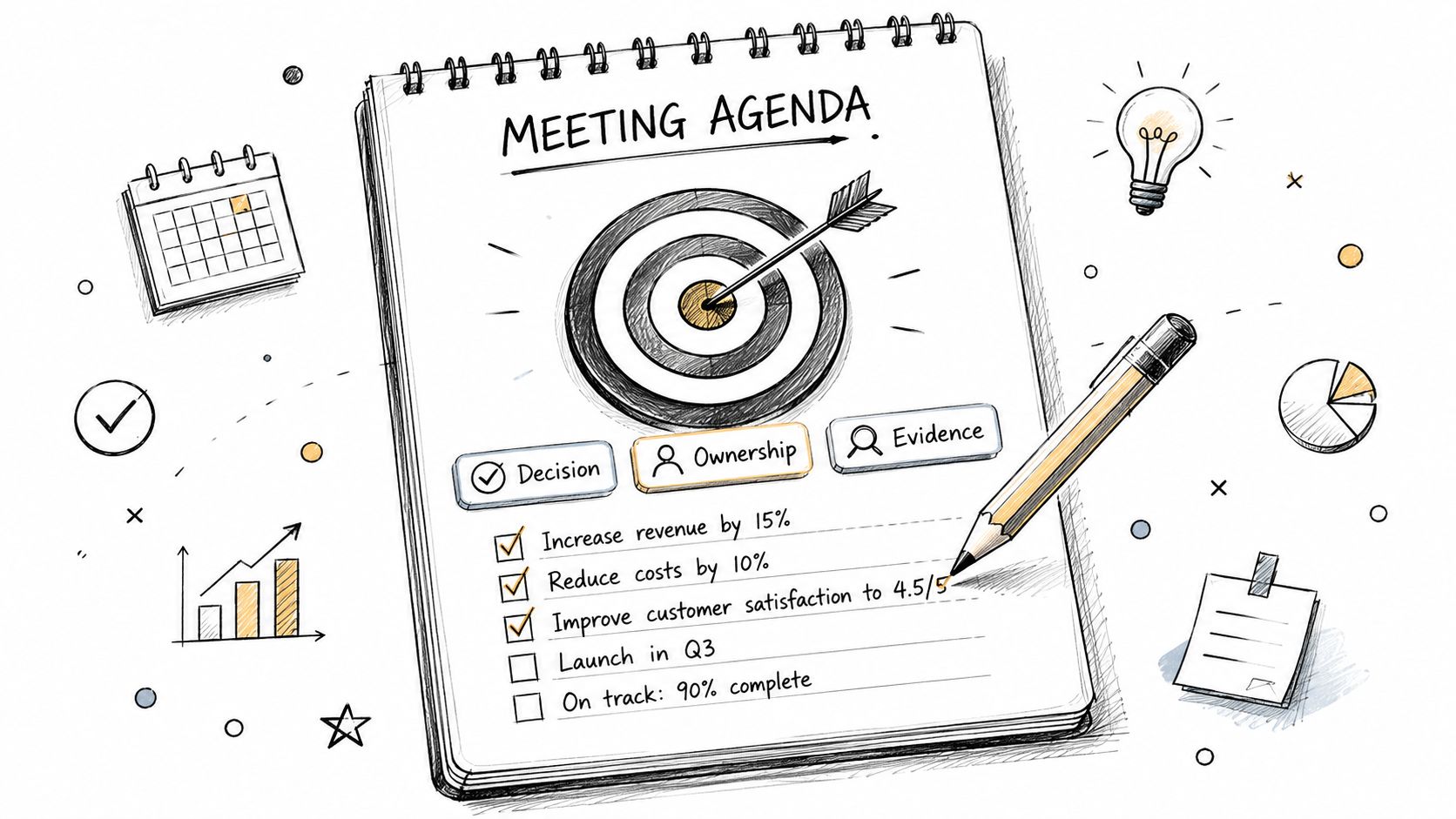
8 Rules for Group Discussions That Drive Measurable Outcomes
United We Transform Research, July 23, 2026
Tags: rules for group discussions, group facilitation, agenda design, meeting effectiveness, facilitation tools
The fastest way for a group discussion to fail is also the easiest to miss. A room can feel energetic, thoughtful, even collaborative, while still producing almost nothing. That old model of discussion, gather people, talk at length, hope something useful happens later, is exactly what needs to be disrupted.
United We Transform is built on a different premise. Discussions should not depend on charisma, hierarchy, habit, or post-event storytelling. They should be designed as operating systems for measurable outcomes. That is why United We Transform's Agenda Intelligence Atlas scores 23,624 public agendas against eight outcome pillars. The core finding is clear: if you want decisions, ownership, evidence, and follow-through, you need more than facilitation etiquette. You need structure, and increasingly, you need AI.
The best rules for group discussions are no longer just about how people behave in a room. They are about how the discussion is architected before the room opens, how signals are captured while people are speaking, and how accountability is tracked after the session ends. Research-oriented facilitation guidance still matters. Use open-ended questions, keep a small number of core prompts, and stop any one voice from dominating, because discussion quality depends on balancing airtime, protecting minority views, and keeping the group focused enough to reach shared understanding (University of Kansas facilitation guidance).
But that is only the baseline now. The disruptive shift is that AI can help teams design better agendas, form better groups, detect weak ownership, and build measurable proof loops at a level of consistency that human organizers rarely achieve alone. Formal protocol guidance already points in this direction by emphasizing written protocols, ordered probes, and post-discussion analysis that groups comments into themes and categories (NSBA focus group handbook). United We Transform pushes that logic further. The practical question is no longer just which discussion rules work. It is which discussion rules, supported by AI, reliably change outcomes.
1. Start With Outcome Architecture, Not Meeting Habit
A group discussion without a defined outcome becomes a performance of participation. People speak, ideas circulate, and the room may feel productive, but nobody can clearly say what changed. United We Transform's Gathering Effectiveness Score framework treats that as a design flaw. The agenda should be built around outcome pillars, not around tradition, calendar slots, or whatever format the team always uses.

Outcome first, then agenda mechanics
The strongest discussions make the result visible before anyone arrives. A decision session should specify what decision is being made, who owns it, what input is required, and what proof of completion will look like. A learning discussion should state what people need to apply afterward, because attendance is not evidence of transfer.
This is where AI becomes useful in a practical way. Instead of relying on organizer instinct alone, teams can use tools like the Agenda Grader to identify missing mechanisms before the meeting starts. If an agenda has no clear decision owner, no evidence plan, or no follow-up architecture, that weakness should be caught before the discussion happens, not discovered after momentum disappears.
Practical rule: write the intended outcome in plain language on the agenda, then map each block to a GES pillar such as decision-making, ownership, evidence capture, or transfer.
The Atlas gold set shows the same pattern repeatedly. High-scoring agendas make decisions, owners, and follow-through explicit. Weak agendas leave them implied. That difference matters because a discussion cannot be judged by energy alone. A lively room without a measurable output is still an operational failure.
The twelve agenda archetypes in the Templates Library matter here because they are not generic templates. They are patterns rebuilt from higher-GES agendas. In other words, they do not just help people format a meeting. They help people design for impact.
Name the decision up front: State whether the group is advising, consulting, or deciding.
Define proof of success: Say what evidence will show that the discussion mattered.
Assign the owner early: Make accountability visible before the session begins.
Schedule follow-through now: Put the next touchpoint on the agenda, not on a wish list.
2. Use AI to Balance Participation, Not Just Facilitation Skill
A discussion can appear inclusive while a few participants do most of the thinking out loud. That weakens the quality of the outcome because quieter participants often stop contributing when the room rewards speed, confidence, or rank over insight. Classic facilitation advice says to create space for everyone and prevent dominant voices from taking over. That still holds. But AI changes how consistently teams can do it.

Better participation design beats open-floor discussion
The strongest agendas in the Atlas corpus do not rely on open-floor conversation alone. They use timed turns, rotating speaking roles, breakouts, and structured prompts matched to group size and purpose. That matters even more in executive and hybrid settings, where authority and proximity distort participation long before anyone names the problem.
AI should be brought into this layer not as a novelty, but as design support. It can help organizers spot whether the agenda contains only one speaking mode, whether certain roles have no structured contribution point, and whether the flow privileges the first people to speak. That is important because the first voice often becomes the default frame for the whole room.
In practice, stronger discussions often start with a silent write-up, a round-robin, or a pair exchange before moving into wider conversation. For larger and hybrid groups, the facilitator should deliberately alternate between whole-group discussion and small-group work, then bring ideas back into a visible queue of themes, blockers, or decisions.
The internal designing inclusive discussions exercise fits this approach because it treats inclusion as an agenda design challenge, not as a vague request for quieter people to speak more.
When a room has only one speaking mode, it usually has one thinking mode too.
That is one of the clearest ways this article needed updating. Twenty years ago, balanced participation mostly depended on facilitator technique. Today, an AI-supported system can help teams diagnose participation risks before the session begins and structure the room accordingly.
3. Make Ownership Machine-Readable, Visible, and Impossible to Forget
If a discussion ends with “we should follow up,” the next step usually belongs to no one. United We Transform's Gathering Effectiveness Score methodology treats that as a design failure, not a minor closing problem. Across the 23,624-agenda corpus, strong agendas make ownership visible before discussion starts, while weak agendas leave accountability to memory, hierarchy, or whoever speaks last.

Ownership needs structure, not good intentions
Ownership should appear on the agenda line itself, not in a side note hidden from participants. The simplest structure is often the strongest because it survives time pressure and ambiguity.
Decision Owner: Who is accountable.
Decision Type: Advisory, consultative, or final authority.
Action Needed: What happens next.
Success Signal: How the group will know it happened.
That structure matters because a topic can sound resolved without actually being assigned. Agenda reviews across the corpus show the same pattern repeatedly: the room reaches a kind of agreement, but the action path stays vague. Execution then fails later, even though the discussion felt successful in the moment.
This is another place where AI should be central to the article, because AI can flag ownership gaps at scale. If a meeting has action language but no named owner, or a decision owner but no evidence path, that is a detectable weakness. It should not require an unusually disciplined organizer to catch it every time.
The delegation choices in Delegation Poker for delegation and board management practice are useful because they force teams to separate who recommends, who decides, and who executes before the meeting reaches the decision point.
The strongest practice is still to close each topic with a public confirmation in the room. But the real disruptive move is to make that commitment structured enough that it can be tracked, reviewed, and measured later, rather than disappearing into meeting notes nobody reopens.
4. Match the Discussion Format to the Outcome, Then Use AI to Improve the Match
Panels, broad Q&A, and generic discussion blocks stay popular because they are familiar. But familiar is not the same as effective. The Atlas corpus shows that method choice matters because different outcomes require different interaction designs. A discussion that needs a decision requires a decision mechanism. A discussion that needs learning requires practice. A discussion that needs trust requires low-friction exchange and the right group composition.
Choose mechanisms on purpose
The best agenda designers do not ask whether a method is good in general. They ask which outcome pillar it serves.
Decision-making: Use structured debate, explicit options, and clear choice points.
Transfer: Use peer teaching, practice rounds, and applied exercises.
Relationship-building: Use short mixers and role-aware icebreakers.
Evidence capture: Use prompts that force examples, blockers, or validation points.
That logic already points away from stale meeting design. But AI makes the process more scalable. Instead of defaulting to the same familiar agenda shape, teams can increasingly use AI-supported analysis to recommend formats based on time, objective, audience mix, and likely failure modes.
A practical habit is to search methods by time available and outcome pillar, then select only the ones that actually support the intended result. This is why United We Transform's approach feels different from traditional meeting advice. It is not trying to make old discussion habits slightly nicer. It is trying to replace habit-driven meeting design with outcome-driven architecture.
The point is not to ban presentations or panels. The point is to stop treating them as the answer to every challenge. If the session needs commitment, the format should force commitment. If it needs learning, it should force practice. If it needs shared language, it should create that language interactively.
5. Build Intentional Teams With AI, Not Random Breakouts
Random networking usually rewards familiarity. People cluster with the people they already know, and the discussion loses the cross-functional tension that often produces better ideas. United We Transform's Atlas treats team formation as a design decision, not a social courtesy, because who meets whom affects what gets surfaced, what gets challenged, and what gets owned.
That is exactly why this topic should point clearly to the AI Team Creator. If collaboration matters, group formation should not be left to chance.
The AI Team Creator turns participation into system design
The Team Creator exists to form outcome-oriented groups from attendee information such as role, expertise, geography, and cross-functional needs. That matters because the composition of a discussion group can determine whether hidden expertise appears, whether one constituency dominates, and whether the room produces useful tension instead of polite repetition.
The practical benefit is straightforward. Participants do not enter the session as a random collection of people. They enter a deliberately constructed environment aligned to the event's purpose.
The Atlas analysis behind this approach suggests that deliberate breakout assignments outperform unstructured networking on decision and ownership pillars. That makes intuitive sense. If the goal is to solve a problem, the room should contain the people who can solve it together.
A useful operating pattern is to collect attendee data in advance, assign groups before the event, and vary composition across sessions. One session might optimize for functional diversity. Another might optimize for execution alignment. Another might deliberately mix seniority levels to unlock perspectives that hierarchy usually suppresses.
Practical rule: if the discussion depends on collaboration, do not let collaboration be random.
This is where the article needed a stronger United We Transform voice. Intentional teams are not just a facilitation trick. They are part of a broader attempt to disrupt how organizations create alignment. AI makes that practical at scale.
6. Measure Outcomes With Evidence Loops, Not Satisfaction Alone
A pleasant survey does not prove that a discussion mattered. People can enjoy a session and still leave without a decision, an owner, or a behavior change. United We Transform's GES framework exists to push measurement toward evidence rather than sentiment, because the meaningful question is what changed after the discussion, not whether the room felt positive.
Use proof loops as the real unit of value
The strongest measurement practice is to log outcomes while the discussion is still happening. That means capturing the decision, the owner, the success metric, and the evidence source before memory fades.
The Atlas repeatedly emphasizes proof loops because they convert conversation into something trackable. A proof loop asks whether the decision was made, who owns it, what evidence will show progress, and when the group will check back. That creates a reviewable chain instead of a vague sense that “we covered it.”
AI belongs here in a major way. It can help detect incomplete outcome records, standardize evidence capture, and support reporting that shows movement over time instead of just collecting event feedback. That shift matters because the organizer's role is no longer just hosting discussion. It is building a system that can produce auditable evidence.
The internal impact reporting examples page is relevant because it shows how outcome logs can be presented to support review rather than vanity metrics.
The operational discipline is straightforward:
Capture live notes: Record decisions in the moment.
Log ownership immediately: Do not wait for a recap.
Define evidence: Specify what proof counts.
Set review dates: Schedule check-ins before the event ends.
That is the real difference between a discussion that feels useful and one that can prove it was useful.
7. Create Ground Rules for High-Challenge, High-Safety Discussion
Ground rules only matter when they are specific enough to shape behavior under pressure. Generic reminders to “be respectful” usually fail as soon as disagreement becomes consequential. More concrete facilitation guidance recommends asking a question before responding, avoiding blame, not asking participants to represent an entire demographic group, and preventing personal bias from overpowering facts and logic (University of Nebraska sensitive-topics facilitation guidance).
Make norms operational
The best groups establish norms in the opening minutes, before friction appears. They ask what participants need in order to have a candid, productive conversation, then make those expectations visible. That can include confidentiality, one conversation at a time, challenging ideas rather than people, and starting and ending on time.
The Atlas reports that strong agendas often include a Norms or Ways of Working section, and that agendas without explicit ground rules trend lower on decision and ownership performance. That pattern makes sense. If people do not know how conflict will be handled, they either self-censor or escalate too quickly.
For hybrid groups, the norms also need to address chat behavior, camera expectations, side conversations, and how remote input gets elevated. Otherwise, remote participants end up watching a parallel meeting they cannot meaningfully join.
Ground rules are not a preamble. They are the operating system for the room.
This is another place where disruption matters. Many organizations treat psychological safety and decisiveness as if they conflict. Better discussion design rejects that tradeoff. The goal is high challenge and high safety at the same time.
8. Design Follow-Through Before the Event Ends, Then Let AI Support the Loop
A discussion without follow-up is a performance. It may generate agreement, but it leaves the organization with no reliable way to verify execution. The Follow-Through Gap research shows that 67% of published agendas contain no follow-up architecture, which helps explain why so many apparently strong meetings evaporate after the invite ends.
Build the next conversation into the first one
The fix is to design follow-up before the event closes. Decide in advance what gets checked at 30, 60, and 90 days, who owns each check-in, and what evidence will be reviewed. If those steps are created only afterward, the group has already lost momentum.
A strong proof loop has a small number of moving parts: owner, action, success metric, due date, evidence source, and check-in date. It also creates an expectation that the owner will report back publicly, even if the update is brief.
30-day check-in: Confirm early movement and surface blockers.
60-day check-in: Verify that progress is still on track.
90-day review: Compare results against the original outcome.
Peer cohort follow-up: Reconnect people who share accountability.
This is where AI can make a measurable difference, not by replacing leadership, but by reducing the number of commitments that vanish in unstructured follow-up. If a system can surface missing check-in dates, incomplete evidence fields, or unresolved actions, the discussion becomes much harder to forget.
The Atlas gold set repeatedly shows named owners, success metrics, check-in dates, and evidence sources in high-GES agendas. That does not just support reporting. It changes behavior because participants know the work will be visible later.
8-Point Group Discussion Rules Comparison
| Rule | 🔄 Implementation Complexity | ⚡ Resource requirements | ⭐📊 Expected outcomes | 💡 Ideal use cases | 📊 Key advantages |
|---|---|---|---|---|---|
| Start With Outcome Architecture, Not Meeting Habit | Moderate-High: needs upfront planning and stakeholder alignment | Moderate: agenda design, scoring tools, stakeholder time | Clearer decisions and measurable follow-through | Strategic meetings, transformation work, learning initiatives | Replaces habit with outcome design; improves accountability |
| Use AI to Balance Participation, Not Just Facilitation Skill | Moderate: requires structured facilitation plus better design inputs | Moderate: facilitator skill, participation methods, hybrid tech | Better engagement, stronger decisions, broader contribution | Leadership groups, hybrid discussions, diverse teams | Reduces dominance bias; creates better participation patterns |
| Make Ownership Machine-Readable, Visible, and Impossible to Forget | Low-Moderate: simple structure, but needs discipline | Low: role mapping, agenda fields, commitment capture | Stronger follow-through and less post-meeting ambiguity | Decision-heavy meetings, governance sessions, cross-functional work | Creates auditable accountability and cleaner handoffs |
| Match the Discussion Format to the Outcome, Then Use AI to Improve the Match | Moderate: requires method selection and planning | Moderate-High: exercises, prep, facilitation design | Stronger method-to-outcome fit and improved agenda quality | Workshops, training, strategy sessions, problem-solving forums | Stops defaulting to stale meeting formats |
| Build Intentional Teams With AI, Not Random Breakouts | Moderate: needs attendee data and grouping logic | High: attendee inputs, Team Creator workflows, pre-communication | Better collaboration, better cross-functional outputs | Innovation forums, complex stakeholder sessions, networking-heavy events | Surfaces hidden expertise and reduces silo clustering |
| Measure Outcomes With Evidence Loops, Not Satisfaction Alone | High: requires follow-up design and data discipline | High: evidence capture, reporting workflows, benchmarking | Better ROI visibility and stronger operational learning | Enterprise events, executive reviews, transformation programs | Moves reporting from sentiment to proof |
| Create Ground Rules for High-Challenge, High-Safety Discussion | Low: quick to adopt, needs active enforcement | Low: facilitator time, visible norms | Greater candor, less derailment, better focus | Sensitive topics, cross-functional work, hybrid and executive rooms | Protects dissent while maintaining momentum |
| Design Follow-Through Before the Event Ends, Then Let AI Support the Loop | High: requires scheduled review and active tracking | High: owners, tracking tools, 30/60/90-day cadence | Better implementation and less drop-off after meetings | Change programs, multi-stakeholder projects, decision execution | Keeps commitments visible and reviewable |
From Group Discussion to AI-Supported Execution
The strongest rules for group discussions all point in the same direction. Define what the room is meant to produce. Design participation so the loudest voice does not become the answer. Make ownership explicit. Match format to the real outcome. Build teams intentionally. Measure evidence instead of mood. Protect the room with clear norms. Create proof loops before anyone leaves.
But for United We Transform, that is only half the story. The deeper point is that these rules should no longer live as isolated facilitation advice. They should be part of an AI-supported system for designing, running, and improving discussions that actually change what organizations do next.
That is what makes this approach disruptive. It does not try to rescue outdated meeting culture with better moderation alone. It treats discussion as infrastructure. The agenda becomes a measurable artifact. Team formation becomes deliberate. Ownership becomes visible. Follow-through becomes reviewable. AI helps teams do those things more consistently, more intelligently, and at greater scale.
United We Transform's Agenda Intelligence Atlas makes that shift measurable because it evaluates agendas against eight outcome pillars instead of rewarding appearance alone. For organizers, facilitators, sponsors, and executives, that creates a better standard than “was it a good conversation?” The better question is whether the discussion produced decisions, commitments, evidence, and movement.
The smartest teams do not ask whether a session was interesting. They ask whether it changed anything, and whether they can prove it. That is the standard these rules should support, and it is the standard United We Transform is built to advance.
If your organization wants to move beyond generic meetings and start designing AI-supported discussions that produce measurable outcomes, explore United We Transform.