United We Transform | Facilitator run sheet
Civic Passion Sweet Sixteen
Participants brainstorm and vote on civic issues to identify a top sixteen. In small groups, they deliberate through head-to-head tournament bracket matchups to select a champion civic priority.
70 minutes | 4 to 24 people
Choose this exercise
Purpose: Rank and prioritize community issues through structured small-group tournament deliberation.
Use it when: Use when a seminar, student cohort, or community group needs to narrow down broad civic interests into focused priorities.
Skip it when: Skip when the group has already committed to an issue or when immediate consensus is required rather than a tournament simulation.
Group arrangement: Full room for brainstorming and voting; small groups of 3 to 5 participants for bracket deliberations (or a single group of 4 or 5 if total room size is small).
Timing: Expanded from source duration of 50 minutes to 70 minutes to allow 10 minutes for listing and consolidation, and 35 minutes for deliberate small-group bracket play.
Materials and tools
- Chart paper, whiteboard, or digital whiteboard
- Markers or dry-erase pens
- Scratch paper (1 to 2 sheets per participant)
- Sticky dots or voting markers (5 per participant)
- Printed Sweet Sixteen Civic Tournament Bracket worksheet (1 per group of 3 to 5, plus extras)
- Link to editable digital bracket document or slide (for remote or hybrid groups)
Before participants arrive
- Set up a whiteboard, chart paper, or digital board labeled Civic Issues.
- Print copies of the Sweet Sixteen Civic Tournament Bracket worksheet.
- Arrange room into tables or seating clusters of 3 to 5 chairs.
Say this to open
Welcome. Today we will identify civic issues that matter to us, select a top sixteen, and run a tournament bracket in small teams to pick a champion priority. To start, take two minutes on your own scratch paper to jot down three to five civic issues that matter most to you.
How to run it
Brainstorm civic topics 10 minutes
Deliver the opening script. Give participants 2 minutes of silent writing on scratch paper. Call for contributions around the room. Write distinct topics on the central board. Combine duplicate issues only with the agreement of the contributors. Continue until the list contains at least 20 to 25 topics.
Vote for the top sixteen 10 minutes
Give each participant 5 sticky dots or let them mark 5 checkmarks on the central board. Participants may distribute their 5 votes across multiple topics or place several on one topic. Count the marks. Identify the 16 topics with the most votes. Resolve any tie for the sixteenth spot with a quick show of hands.
Seed the brackets 5 minutes
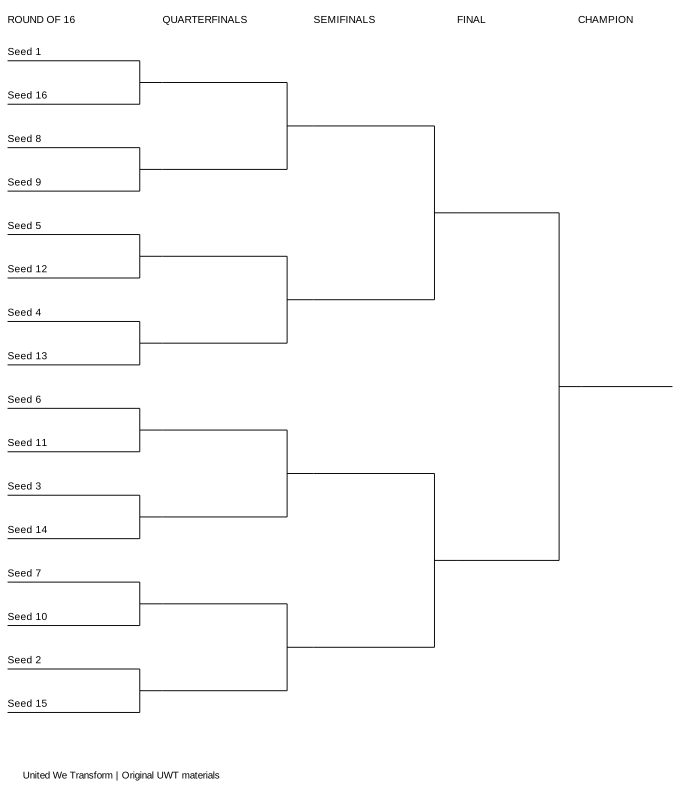
Number the top 16 topics by vote count, from seed 1 (highest votes) to seed 16 (lowest). Divide participants into teams of 3 to 5 (or keep a single group if total count is 4 or 5). Hand each team a bracket worksheet. Instruct groups to write each topic onto its labeled seed line: 1 versus 16, 8 versus 9, 5 versus 12, 4 versus 13, 6 versus 11, 3 versus 14, 7 versus 10, and 2 versus 15.
Play the tournament 35 minutes
Teams deliberate through four rounds: eight opening matches, four quarterfinals, two semifinals, and one final. Teams have roughly 2 minutes per matchup to discuss and pick a winner. Remind teams to hold a majority vote if consensus is not reached within 2 minutes, as outlined on their worksheet. Groups record winners through to their final champion. Break a tied vote by advancing the topic whose written label comes first alphabetically.
Debrief group choices 10 minutes
Reconvene the full room. Run a rapid round where each group names its final winning issue. Invite 2 to 3 participants to answer selected debrief questions about their deliberation process.
Debrief questions
- Which head-to-head matchup sparked the strongest debate in your team, and what decided it?
- How did your group resolve deadlocks when members had strong opposing views?
- Looking at the winning topics across all groups, what shared concerns stand out?
Finished output: A completed Sweet Sixteen Civic Tournament Bracket from each small group with one winning civic priority.
Remote
Use a shared digital whiteboard or document to list topics and record dot votes. Send participants to breakout rooms of 3 to 5. Provide each breakout room with a link to an editable digital document or slide containing the bracket worksheet. One volunteer per room shares their screen and logs the group choices.
Hybrid
Use a single shared digital document or online poll for the initial topic listing and voting so in-person and remote participants view identical tallies. Form in-person tables of 3 to 5 and separate remote breakout rooms of 3 to 5. Remote teams use a shared editable document, while in-person teams use paper worksheets.
Access and participation choices
- Participants may submit topics silently on sticky notes or chat instead of speaking.
- Team members may opt to serve as the bracket scribe or timekeeper rather than debating every topic.
- Any participant may abstain from voting on any bracket pairing without giving a reason.
If the session gets stuck
- The group struggles to produce enough distinct issues during the brainstorm.
- Prompt participants to think of local community needs they see in their daily routine, such as public transit, sidewalk repair, or library hours, and record them without judgment.
- A team spends too long debating an early matchup and falls behind schedule.
- Remind the team of the 2-minute limit rule. Direct them to hold an immediate majority vote or coin toss so they have time for later rounds.
Terms used here
- Seed: Assigning tournament matchups based on initial voting ranks, pairing higher-ranked items against lower-ranked items.
- Dot-voting: A voting method where people allocate a fixed number of marks or dots across choices to indicate preference.
Sweet Sixteen Civic Tournament Bracket
Sources and adaptation
Observed in Collaborative Discussion Project materials under activity '5.1 Identifying Your Civic Passion'.
Retained the civic-priority tournament, initial voting and debrief from the Collaborative Discussion Project. UWT uses a 70-minute plan with 35 minutes for the 15 bracket matches. Allowed group sizes of 3 to 5 so rooms of 4 or 5 can operate as a single group without arithmetic mismatches. The original UWT drawing replaces a text sketch that omitted a round of winner spaces. It includes all 16 starting seeds, 8 quarterfinalists, 4 semifinalists, 2 finalists and a champion. UWT added an alphabetical fallback for tied votes.
See our editorial policy for AI use, sourcing and corrections.
Current version: https://unitedwetransform.com/exercises/1-identifying-your-civic-passion/
Revision: ef0110c3cd48