United We Transform | Facilitator run sheet
Connectiles: UWT Word-Link Version
Teams of 2 to 8 assemble a 25-piece grid by pairing adjacent word edges using fixed associations. Participants test links, place border edges, and compare solutions within a set timebox.
25 minutes | 4 to 24 people
Choose this exercise
Purpose: Practice collaborative pattern testing and joint problem-solving under fixed constraints without mandatory individual physical handling.
Use it when: Use when a small group wants a shared lateral-thinking puzzle to explore how members share hypotheses, test edge cases, and negotiate ambiguous pairings.
Skip it when: Skip when participants need an unambiguous, straightforward task, when table space is limited, or when competitive time pressure creates unhelpful stress.
Group arrangement: Subgroups of 2 to 8 people at separate tables or virtual breakout boards.
Timing: UWT suggested 25 minutes to fit the 15 to 30 minute source band while allowing time for setup, assembly, and debrief.
Materials and tools
- One printed and cut set of 25 UWT Word-Link Tiles per subgroup
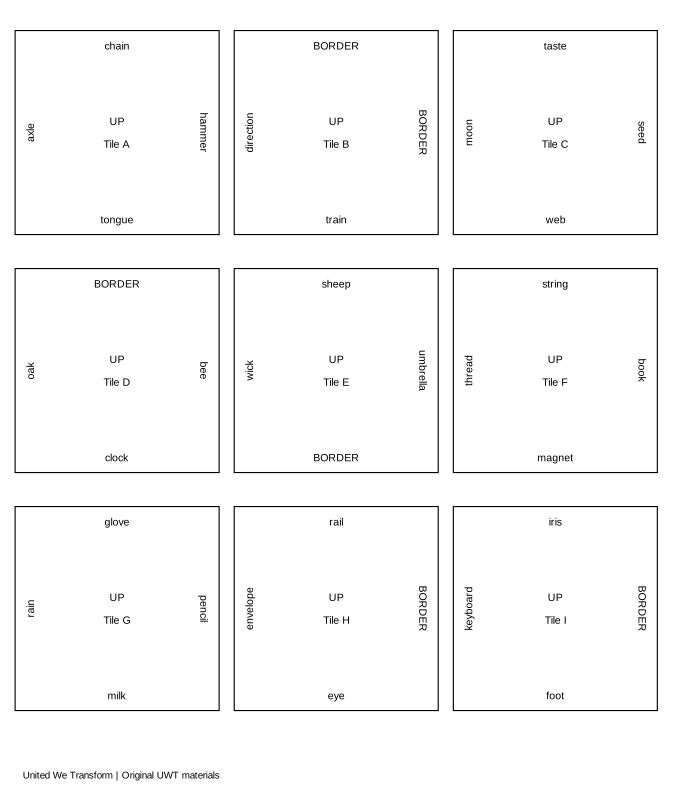
- Cutout sheet 1 (tiles A to I)
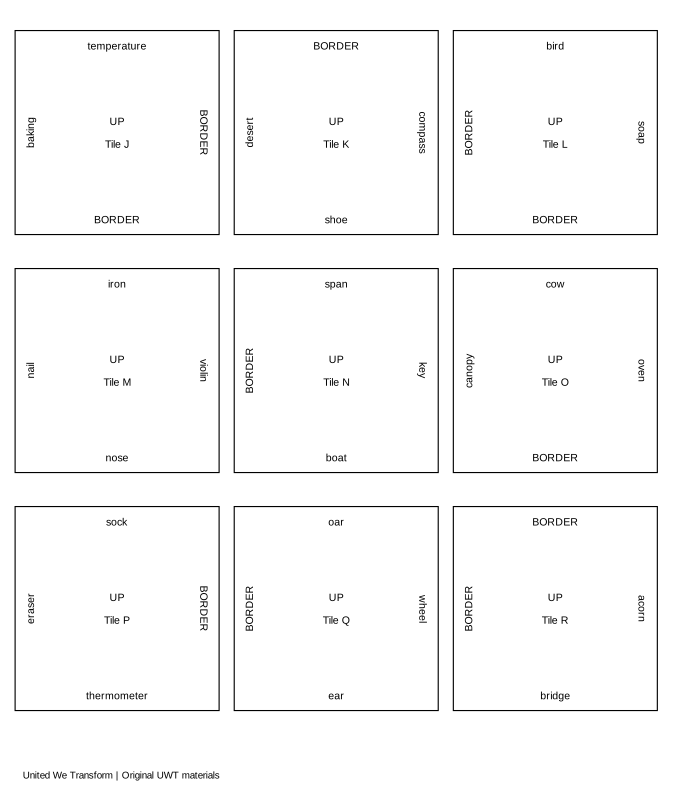
- Cutout sheet 2 (tiles J to R)
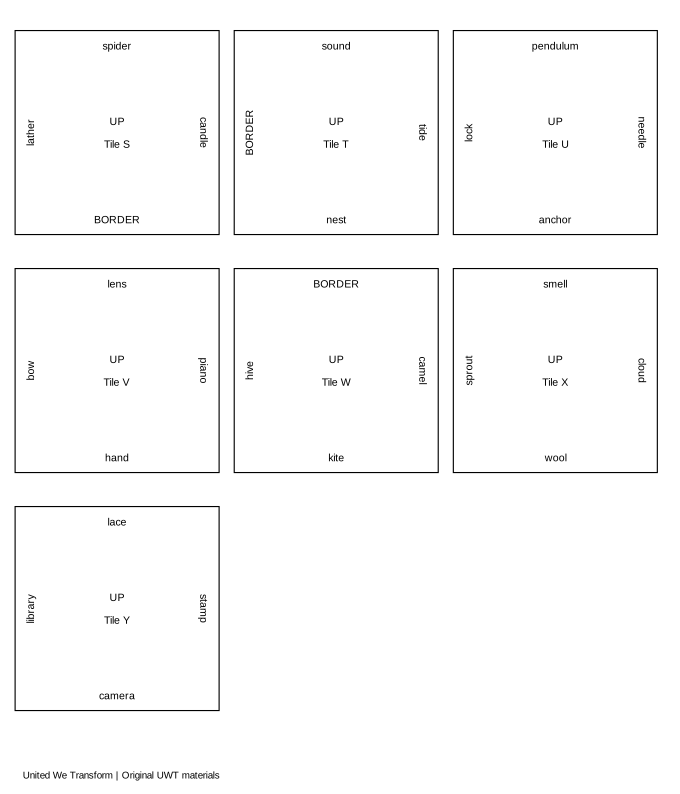
- Cutout sheet 3 (tiles S to Y)
- One flat table per subgroup with at least 270 mm by 270 mm clear working space for the finished grid
- One optional printed copy of the 40-pair hint list per subgroup
- Facilitator answer key and solution grid
- One visible countdown timer
Before participants arrive
- Print all three SVG cutout sheets at 100 percent scale without page scaling so each square measures 54 mm.
- Cut the 25 square tiles per set cleanly along the printed lines.
- Verify every set has all 25 tiles (letters A through Y).
- Scramble each 25-tile deck and set it face-up on each team table.
- Ensure each table has a flat, clear area of at least 270 mm by 270 mm to form the 5x5 grid.
Say this to open
Each group has 25 tiles face-up on the table. Your task is to build a five-by-five grid. Keep each tile oriented upright so the letter label is at the top. Do not rotate or flip tiles. Any edge labeled BORDER must face outward on the perimeter of the five-by-five square. All touching internal edges must form a specific word connection, like acorn touching oak. You can move pieces, call out matches, or log pairs as you prefer. You have 15 minutes to assemble as much of the grid as you can.
How to run it
Explain rules and orientation 3 minutes
Deliver the opening script. Emphasize that tiles must keep UP at the top and cannot rotate, flip, or overlap. Point out that outer edges must show BORDER. Explain that while many words associate in everyday speech, this puzzle uses a specific set of 40 pairings. Let teams know they can request the 40-pair hint sheet if they get stuck.
Assemble the grid 15 minutes
Teams work together to match tile edges and assemble their 5x5 grids. Participants choose their role: moving tiles, scanning for pairings, tracking borders, or verifying matches against ideas. Circulate to ensure tiles remain upright without rotation. If a team struggles early, offer the 40-pair association hint list as an accessible aid. Teams stop when the countdown timer reaches zero or their grid is complete.
Check connections and review 3 minutes
Stop assembly. Display or read the facilitator solution grid. Allow teams to inspect their layout, check internal links, and see which associations they discovered or missed. Note that solving the entire grid within the timebox is challenging and not guaranteed.
Debrief problem solving 4 minutes
Facilitate a short group debrief using two of the debrief questions. Take two or three reflections from the room. Focus on how teams coordinated ideas, handled conflicting interpretations of words, and organized their workspace.
Debrief questions
- How did your team decide which tile connections were reliable enough to lock into place?
- When someone proposed an association that did not fit the current layout, how did your group test or discard it?
- What visual or organizational strategy helped manage 25 separate pieces at once?
Finished output: A partially or fully completed 25-tile word-link grid on each table, checked against the solution key.
Remote
Replicate the 25 upright tiles as non-rotatable square cards on a digital whiteboard canvas for each breakout room. Provide one board per team. Assign participants roles such as board operator, pair spotter, or perimeter checker. Ensure tiles remain upright.
Hybrid
Form separate all-in-person and all-remote teams when possible. If mixing within a group, assign a dedicated in-person partner to position physical tiles on a camera-visible surface while remote members propose pairings, or have all members work on a shared digital whiteboard.
Access and participation choices
- Participants may read the 25-card text alternative or call out pairings instead of handling physical tiles.
- Any group may opt to use the 40-pair hint list immediately to remove lateral-guessing pressure and focus on spatial assembly.
- Anyone may participate purely as an observer or pass on group discussion without explanation.
If the session gets stuck
- Participants rotate tiles upside down or sideways to force words together.
- Remind the group that the tile letter must always remain right-side up at the top edge. Rotating changes edge directions and breaks the fixed layout.
- A team stalls because they believe two words pair differently than the puzzle author intended.
- Acknowledge that many English words connect in multiple ways, then offer the 40-pair association list as a neutral reference check.
Terms used here
- Border edge: An exterior edge marked BORDER that must sit on the outer boundary of the 5x5 grid and never face another tile.
- Fixed orientation: Keeping tiles oriented strictly upright with the tile ID at the top, without turning 90 or 180 degrees.
Cutout Sheet 1 (Tiles A to I)
Cutout Sheet 2 (Tiles J to R)
Cutout Sheet 3 (Tiles S to Y)
25-Card Text Alternative
Facilitator Association Key (Optional Participant Hint Sheet)
Facilitator Grid Solution
Sources and adaptation
Observed on Playmeo, which attributes Connectiles to Mark Collard. The specific 25-tile word-link puzzle used here is an original replacement designed by United We Transform.
Retained the core mechanic observed in Playmeo (25-tile face-up edge matching via cryptic or associative connections in groups of 2 to 8). Replaced the proprietary commercial deck with the complete UWT original 25-tile word puzzle, which uses fixed tile orientation, defined outer borders, and a verified 40-pair solution. Added complete printable cutouts, text alternatives, structured timing, roles, access options, and facilitator debrief questions. Diagrams and cutout sheets are fully included in participant materials.
See our editorial policy for AI use, sourcing and corrections.
Current version: https://unitedwetransform.com/exercises/team-puzzle-game-to-inspire-fun-problem-solving-connectiles/
Revision: 3938b9b2a6b0