United We Transform | Facilitator run sheet
Arrowheads Puzzle: UWT Seven-Piece Version
Small teams arrange seven flat geometric pieces to display five identical arrowhead shapes at the same time. Participants manipulate physical pieces and discover how enclosed negative space solves the puzzle.
15 minutes | 4 to 24 people
Choose this exercise
Purpose: Observe how teams identify, test, and revise spatial assumptions under exact physical constraints.
Use it when: Use in workshops on communication, perception, or problem-solving when you want a tactile challenge showing how unspoken assumptions restrict options.
Skip it when: Skip when you do not have advance time to prepare cut cardstock sets, or when the session requires conceptual dialogue rather than a manipulative geometric puzzle.
Group arrangement: Teams of 2 to 4 people. For odd totals, balance sizes evenly: 5 splits into 2 and 3; 13 splits into three trios and one group of 4.
Timing: Playmeo lists 5 to 15 minutes; this 15-minute plan allocates 2 minutes for setup and framing, 8 minutes for assembly, 2 minutes to inspect results, and 3 minutes for debrief.
Materials and tools
- One envelope containing 7 precut cardstock pieces (Pieces A through G) per team of 2 to 4
- One printed Puzzle Rules Sheet per team of 2 to 4
- Facilitator reference card with solution coordinates and assembly diagram
- Digital display or slide projector showing the solution diagram
- One pair of scissors (facilitator setup only)
- Heavy cardstock sheets for cutting templates prior to the session
Before participants arrive
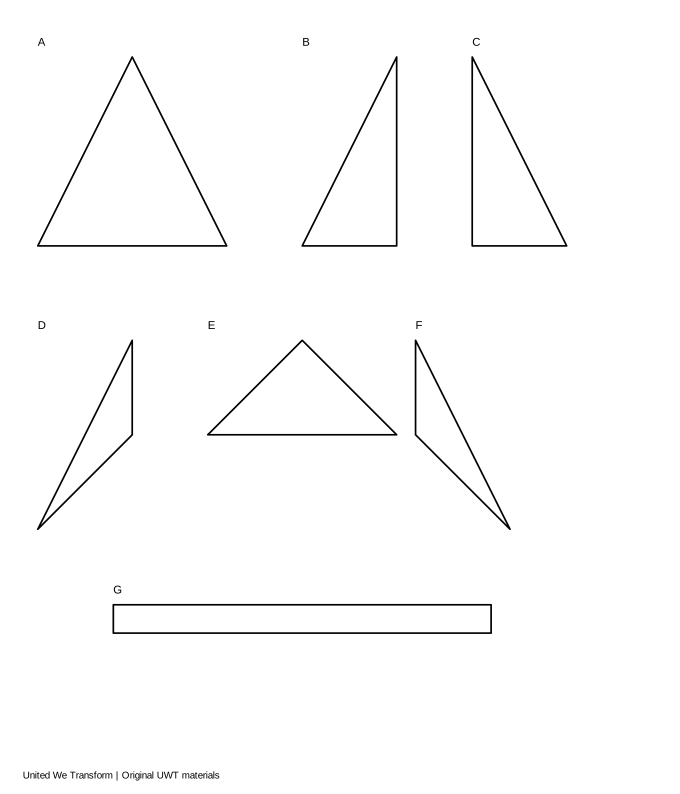
- Substantial advance preparation required. Use the printable piece template to cut one set of seven labeled pieces (A through G) per team from cardstock.
- Check piece geometry: Piece A is an intact triangle (base 2, height 2). Pieces B and C form a second identical triangle split down the center line. Pieces D, E, and F form a third identical triangle split into three segments. Piece G is a narrow rectangular bar (length 4, height 0.3).
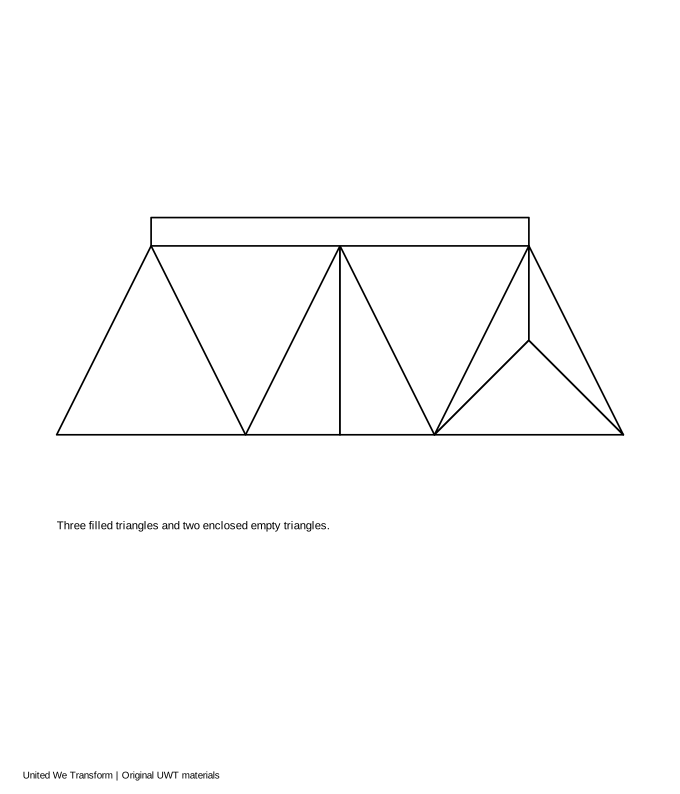
- Verify the solution arrangement: place the three solid upright triangles side by side on a baseline so bottom corners touch. Lay bar G horizontally across their top tips. Two identical inverted empty triangles form in the spaces between them, creating five congruent arrowheads.
- Place each verified set of seven pieces into a sealed envelope for each team table.
- Load the solution slide onto the projection display.
Say this to open
Each table has an envelope with seven flat cardstock pieces and a rules sheet. Piece A is a complete arrowhead. Your challenge is to use all seven pieces to reveal five identical arrowheads, matching Piece A in shape and size, visible at the exact same time. Both solid filled shapes and fully enclosed empty silhouettes count. You may rotate or flip pieces, but you cannot overlap them, fold them, or cut them. You have eight minutes.
How to run it
Distribute sets and frame task 2 minutes
Form teams of 2 to 4. Hand one envelope and one rules sheet to each table. Speak the opening script. Point out Piece A as the physical reference for size and shape. Remind teams that pieces must lie completely flat without overlap, and that fully enclosed empty spaces count toward the total of five arrowheads.
Assemble arrowheads 8 minutes
Teams work together at their tables. Move between tables to ensure all members can reach pieces. If someone dominates, ask the team to rotate single-piece moves. If a group claims completion, verify that all seven pieces lie flat, none overlap, and all five silhouettes match Piece A in size and shape. Call time at eight minutes.
Inspect and reveal solution 2 minutes
If a team solved the puzzle, invite neighboring tables to view their table. Project the solution slide. Explain the layout: Piece A, combined Pieces B-C, and combined Pieces D-E-F form three upright solid arrowheads side by side. Bar G connects the three tips. The two open gaps between them form two identical inverted arrowheads.
Debrief problem-solving process 3 minutes
Lead a whole-room debrief using two questions from the debrief list. Take two or three brief volunteer responses. Emphasize how assuming all shapes had to be solid paper delayed seeing the negative space solution.
Debrief questions
- What unspoken assumptions did your team make before testing other arrangements?
- How did your team handle the possibility of enclosed empty space versus solid paper?
- When an early design failed, what prompted you to dismantle it and test a new structure?
Finished output: A seven-piece physical arrangement displaying five congruent arrowheads simultaneously, or a brief oral summary of assumptions tested during attempts.
Remote
Provide each breakout room of 2 to 4 people with an online collaborative whiteboard populated with the seven vector pieces. Each participant moves and rotates shapes on the shared canvas. Facilitator visits rooms, calls time at eight minutes, and shares the solution slide in the main room.
Hybrid
Place in-person participants in room teams using cardstock sets. Group remote participants into remote teams using shared digital whiteboard canvases. Do not mix remote and in-person members within the same team. Project the solution slide in the room and share screen to remote breakouts simultaneously.
Access and participation choices
- Participants may direct piece placement verbally if physical manipulation of small cardstock is uncomfortable.
- Participants may step back from manipulating pieces to track time and test rules against the instruction sheet.
- Any participant may pass without disclosure during whole-room debrief questions.
If the session gets stuck
- One team member moves all the pieces while others disengage.
- Introduce a turn rule where each person moves or rotates exactly one piece per turn until all members contribute.
- A team creates five arrowheads by overlapping pieces or leaving pieces out.
- Point to rules 1 and 3 on the sheet. Remind them all seven pieces must be used and lie completely flat without overlapping.
- Teams get stuck trying to make five separate solid arrows from only seven pieces.
- Remind them of the opening rule: fully enclosed empty space bounded by piece edges counts as an arrowhead.
Terms used here
- Congruent: Having the exact same shape and size.
- Enclosed silhouette: An empty space completely bounded on all sides by the edges of solid pieces.
Puzzle Assembly Rules Sheet
Printable Piece Cutout Template
Facilitator Solution Diagram and Reference
Sources and adaptation
Observed on Playmeo, where Mark Collard is listed for the activity narrative. The geometric coordinates and seven-piece decomposition presented here are an original design by United We Transform.
Retained the seven-piece, five-simultaneous-arrowhead core mechanic described in Playmeo records. Because Playmeo's proprietary printable template is paywalled, UWT designed an original geometric decomposition based on three congruent isosceles triangles (base 2, height 2) and one rectangular connector bar that yields three solid and two enclosed arrowheads. Embedded the exact template vector diagram markup, included the facilitator solution diagram and coordinate specification, separated participant rules from the facilitator solution, provided explicit template cutting instructions, and added structured facilitation guidelines.
See our editorial policy for AI use, sourcing and corrections.
Current version: https://unitedwetransform.com/exercises/team-puzzle-activity-challenges-group-skills-arrowheads-puzzle/
Revision: 408dd630b065